
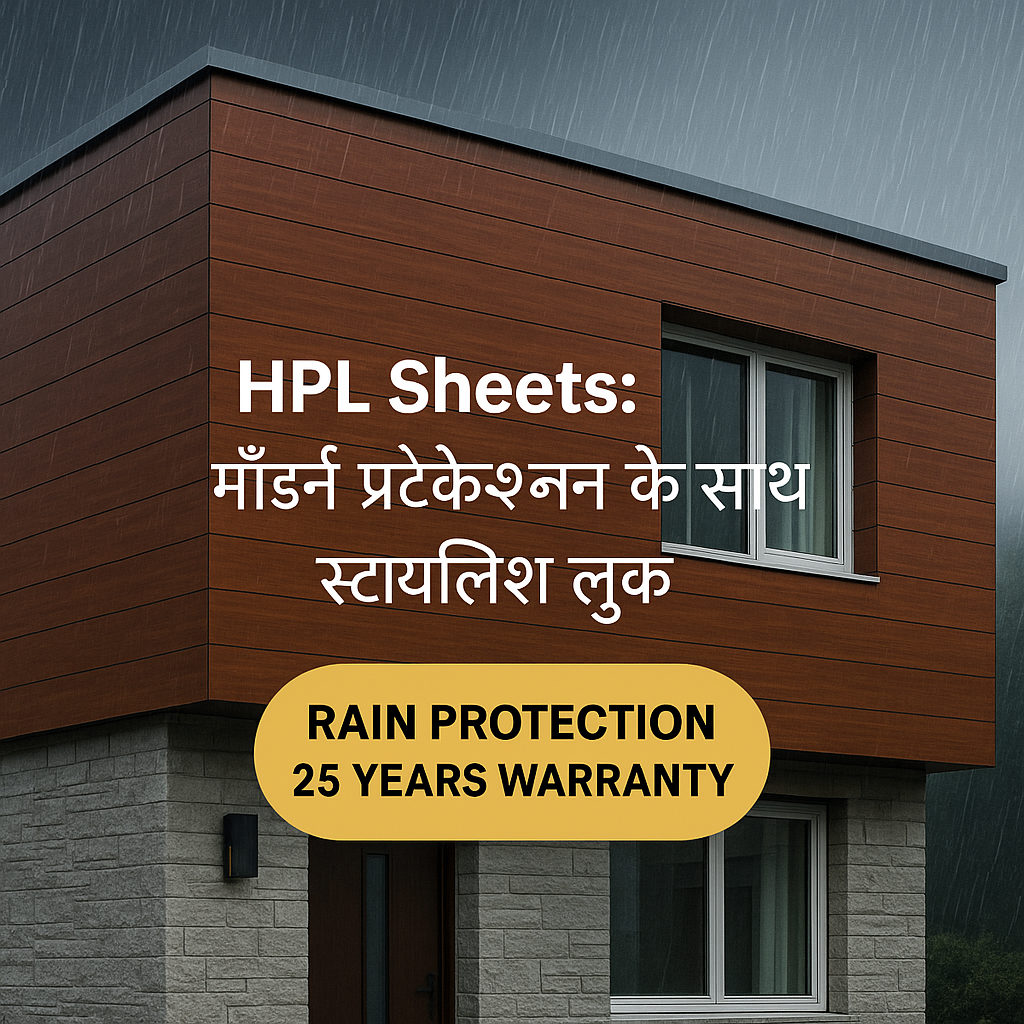
High-Pressure Laminate (HPL) is made by bonding multiple layers of kraft paper soaked in phenol resin, topped with a decorative layer soaked in melamine, and then pressing the whole thing together under extreme heat and pressure — typically above 1,000 psi.
The result? A dense, hard surface that resists scratches, moisture, UV rays, heat, and even fire to a significant degree.
It’s not paint. It’s not veneer. It’s not a surface coating. HPL is a structural surface material — and that distinction matters when you’re comparing it with cheaper alternatives.
Interior vs Exterior HPL: This Is the Most Misunderstood Difference
Walk into any hardware shop and ask for “HPL sheets” — and there’s a good chance they’ll show you interior-grade panels. These look similar, cost less, and will absolutely fall apart on an outdoor facade within a year or two.
Here’s the fundamental difference:
Interior Grade HPL
- Designed for controlled environments — kitchens, cabinets, office partitions, hospital walls
- Typically 0.6mm to 1.5mm thick
- No UV protection, minimal moisture resistance
- Not suitable for direct rain or sunlight exposure
Exterior Grade HPL
- Engineered for weather, UV radiation, humidity swings, and temperature changes
- Typically 6mm and above in thickness
- UV-stable surface that won’t fade or chalk over years
- Tested to international standards (EN 438 is the global benchmark)
The rule is simple: if any part of the sheet will ever see sunlight or rain, go exterior grade — no exceptions.
HPL Sheet Thickness Guide: Which One Do You Actually Need?
Thickness is one of the most common points of confusion for first-time buyers. Here’s a practical breakdown:
| Thickness | Best Use Case |
|---|---|
| 0.6mm – 1mm | Furniture surfaces, drawer fronts, light interior panels |
| 1.5mm – 3mm | Countertops, wall cladding (interior), workstations |
| 4mm – 6mm | Exterior cladding, balcony panels, canopies |
| 8mm – 12mm | Heavy commercial facades, high-traffic public areas |
Most residential exterior projects in India use 6mm exterior-grade HPL. It balances weight, structural rigidity, and cost. Going thinner on an exterior job is the most common mistake people make — and one you’ll pay for with warping, cracking, or delamination.
HPL Sheet Price in India: What’s a Fair Range?
Prices vary based on thickness, grade, brand, and finish. As a rough benchmark for 2025:
- Interior grade (1–3mm): ₹80 – ₹200 per sq ft
- Exterior grade (6mm): ₹180 – ₹400 per sq ft
- Premium/designer finishes: ₹350 – ₹600 per sq ft
If someone quotes you ₹90 per sq ft for “exterior grade 6mm HPL” — be skeptical. Either the thickness isn’t what they say, the grade isn’t exterior-certified, or the raw material quality has been compromised somewhere.
Cheap HPL has a way of revealing itself — usually during the second monsoon.
5 Things to Check Before You Place Any Order
1. Ask for the Test Certificate, Not Just the Promise
Any manufacturer worth trusting will have third-party test reports for UV resistance, moisture resistance, and fire behavior. Ask for them. If they can’t share these documents, walk away.
2. Check the Warranty — and What It Actually Covers
A warranty on HPL sheets should cover delamination, fading, and structural failure. Read the fine print. Some warranties cover “manufacturing defects” only, which is almost meaningless in practice because a defect has to be proved during manufacturing.
Look for warranties that are performance-based — covering the material’s behavior over time, not just how it left the factory. HPL Maker offers up to a 25-year warranty with live camera verification — meaning you can track your product’s performance over its entire lifetime. That kind of commitment is rare in the Indian market.
3. Don’t Ignore the Core Material
HPL sheets consist of layers of paper. The quality of the kraft paper and the resin used in those layers directly affects moisture resistance and long-term stability. Virgin kraft paper performs significantly better than recycled alternatives. Ask your supplier what goes into their core.
4. Match the Finish to the Environment
Gloss finishes look stunning in showrooms and on marketing brochures. On an exterior facade in a dusty city or coastal area, they show fingerprints, grime, and weathering much faster than matte or textured finishes.
For exteriors, matte, brushed, or embossed textures tend to hold up better visually over time. Keep this in mind before you fall in love with a high-gloss wood grain finish for your building’s facade.
5. Verify the Supplier Stocks Full-Size Panels
Standard HPL sheet sizes run from 8 ft x 4 ft up to 12 ft x 4 ft. If your project involves large uninterrupted facades, you need full-size sheets to avoid visible joints. Some distributors only stock smaller cut sizes — which can affect both aesthetics and structural integrity.
HPL vs ACP: The Comparison Every Homeowner Asks About
Aluminium Composite Panels (ACP) have been the default exterior cladding choice in India for years. HPL is increasingly replacing them. Here’s why:
| Feature | HPL Sheet | ACP (Aluminium Composite Panel) |
|---|---|---|
| Durability | 20–25 years | 10–15 years (surface prone to denting) |
| Fire Resistance | Inherently fire-retardant (Class A rated) | Standard ACP has a flammable PE core |
| Maintenance | Low — wipe clean, no repainting | Moderate — prone to oxidation, surface damage |
| Aesthetics | Rich textures, matte/gloss, wood/stone looks | Metallic look dominant, limited texture range |
| Eco Profile | Made with recyclable materials, low-emission resins | Aluminium production is energy-intensive |
| Cost | Slightly higher upfront | Lower upfront, higher long-term maintenance |
After several high-profile fires involving ACP cladding in India and globally, building codes have tightened significantly. Architects and project owners are moving toward HPL not just for aesthetics but for safety compliance.
Installation Basics: What Can Go Wrong
Even the best HPL sheet will fail if it’s installed incorrectly. These are the most common installation errors:
No expansion gaps. HPL expands and contracts with temperature changes. If sheets are installed too tight without the recommended gap (typically 3–5mm between panels), they buckle or crack.
Wrong substrate. HPL needs a stable, flat substrate. Using uneven or soft backing material causes flex, which leads to delamination over time.
Exposed edges not sealed. The cut edges of HPL are more vulnerable to moisture. All cut edges should be sealed with appropriate edge sealant, especially in exterior applications.
Using interior adhesive on exterior applications. Sounds obvious, but it happens more than you’d think. Always verify that the adhesive and fixing system is rated for outdoor use.
A professional installation crew familiar with HPL panels will make the difference between a facade that looks stunning for 20 years and one that starts showing problems within two.
Who Should Be in the Room When You Decide
If you’re doing a residential project, you want your architect or interior designer to sign off on the grade and finish before you order. They’ve seen projects succeed and fail — and they’ll catch things a catalog won’t tell you.
For commercial and institutional projects, get the HPL specification into your tender documents clearly — grade, thickness, test standard, and warranty terms. Vague specifications lead to substitutions that look the same on invoice but perform very differently on site.
Final Thought
HPL sheets are one of the most durable, low-maintenance, and design-flexible surface materials available in the market today. Chosen correctly and installed properly, they’ll outlast paint cycles, resist weather your building will face, and look sharp doing it.
But they’re not a commodity. The difference between a sheet that costs ₹150 per sq ft and one that costs ₹350 isn’t just brand margin — it’s raw material quality, manufacturing process, UV stability, and the confidence a manufacturer has in standing behind their product for two decades.
Buy from someone who’ll still be answering your call in year fifteen.
Looking for exterior HPL sheets with verified quality and a 25-year warranty? Explore HPL Maker’s range — India’s trusted manufacturer for residential and commercial HPL solutions.