
Biophilic design — connecting buildings to nature through natural materials and textures — is the dominant facade trend of 2026, and wood-look finishes are how it shows up on elevations. For Indian projects, wood-look HPL delivers that warmth without the polishing cycles, termite risk and monsoon movement that real timber brings.
Why Architects Are Specifying Natural Looks
The preference for warm, natural textures has moved from a styling choice to a design philosophy. Cedar, ipe, walnut and teak looks now dominate both residential and commercial exteriors internationally, and the same shift is visible in Indian specification.
The reasoning is not purely aesthetic. Buildings clad in natural tones read as calmer and more contextual, they age visually better than saturated trend colours, and they photograph well — which matters more than architects like to admit when a project becomes a portfolio piece.
The Problem With Real Timber in India
Specifying real wood on an Indian facade means accepting a maintenance programme, not a material choice:
- Exterior wood finishes need reapplication every 12 to 24 months, with sanding back of failed areas
- UV exposure greys untreated timber within months
- Seasonal humidity causes cupping, joint opening and dimensional movement
- Termite risk is significant across most of the country
- Fungal staining appears quickly in high-humidity zones
- Quality exterior hardwood prices have risen steadily
On a client project, this means either a maintenance budget nobody funded, or a facade that looks poor within three years.
How Wood-Look HPL Delivers the Same Intent
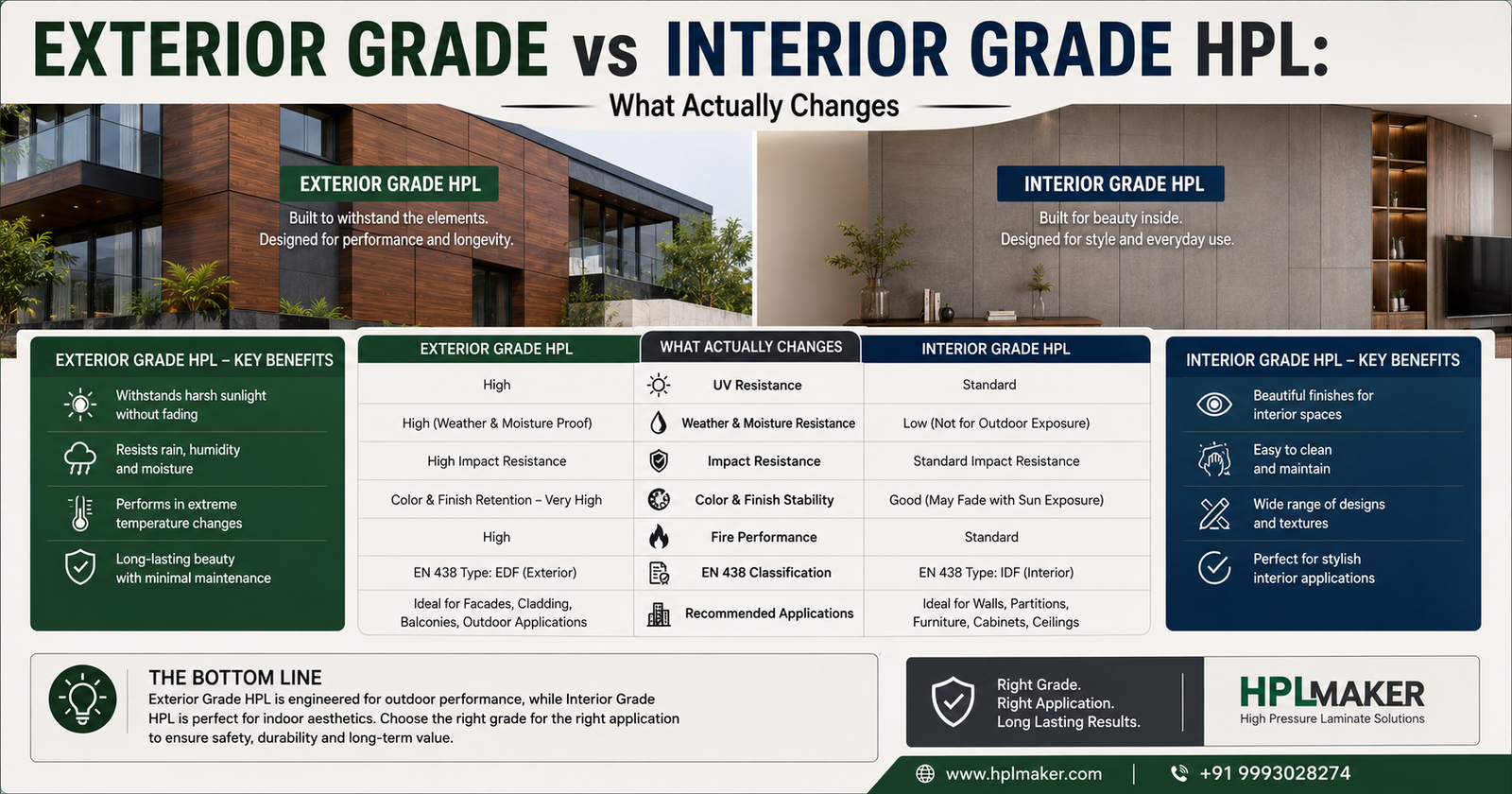
HPL’s decorative layer is a high-resolution printed paper sealed beneath a clear overlay and, on exterior grades, a UV-cured coating. Modern printing combined with surface texturing that follows the grain produces a convincing result at normal viewing distance.
What the specifier gains: no re-coating cycle, no termite exposure, no seasonal movement, no greying, and a service life of 15 to 25 years with routine washing only.
Specifying It Well
A wood-look facade succeeds or fails on detailing, not on the sheet.
- Specify textured, not flat. A surface texture registered to the printed grain is what separates convincing from laminate-looking.
- Vary board widths. Uniform identical strips read as manufactured. Mixed widths mimic real timber cladding.
- Use shadow gaps. Depth and shadow lines are what the eye reads as wood. A flush butt joint kills the effect.
- Check pattern repeat length. If the same knot recurs every third panel, the illusion breaks at a glance.
- Orient deliberately. Vertical slats add height on narrow frontages; horizontal boarding emphasises breadth on wide plots.
Combining With Other Materials
Biophilic facades rarely use a single finish. The strongest compositions pair a wood-look on entrance and human-scale volumes with a stone or neutral solid on the surrounding mass. The wood is then read as an accent of warmth rather than as a whole-building cladding, which is also how natural timber is used in good architecture.
Frequently Asked Questions
What is biophilic facade design?
Designing building exteriors to connect occupants with nature through natural materials, textures, colours and forms. On facades it typically means wood and stone finishes in earthy tones.
Does wood-look HPL satisfy biophilic design intent?
It delivers the visual and tactile warmth of timber. Purists argue authentic materials matter; practically, a maintained wood-look facade often reads better at year five than a neglected real timber one.
Which wood finishes are trending in 2026?
Cedar, ipe, walnut and other warm natural tones, in matte rather than gloss surfaces.
How long does wood-look HPL last on an Indian facade?
Exterior-grade HPL with UV-cured coating typically performs for 15 to 25 years with routine cleaning.
Specifying a biophilic facade? Contact HPLMaker for the wood-decor range, textures and technical documentation.