
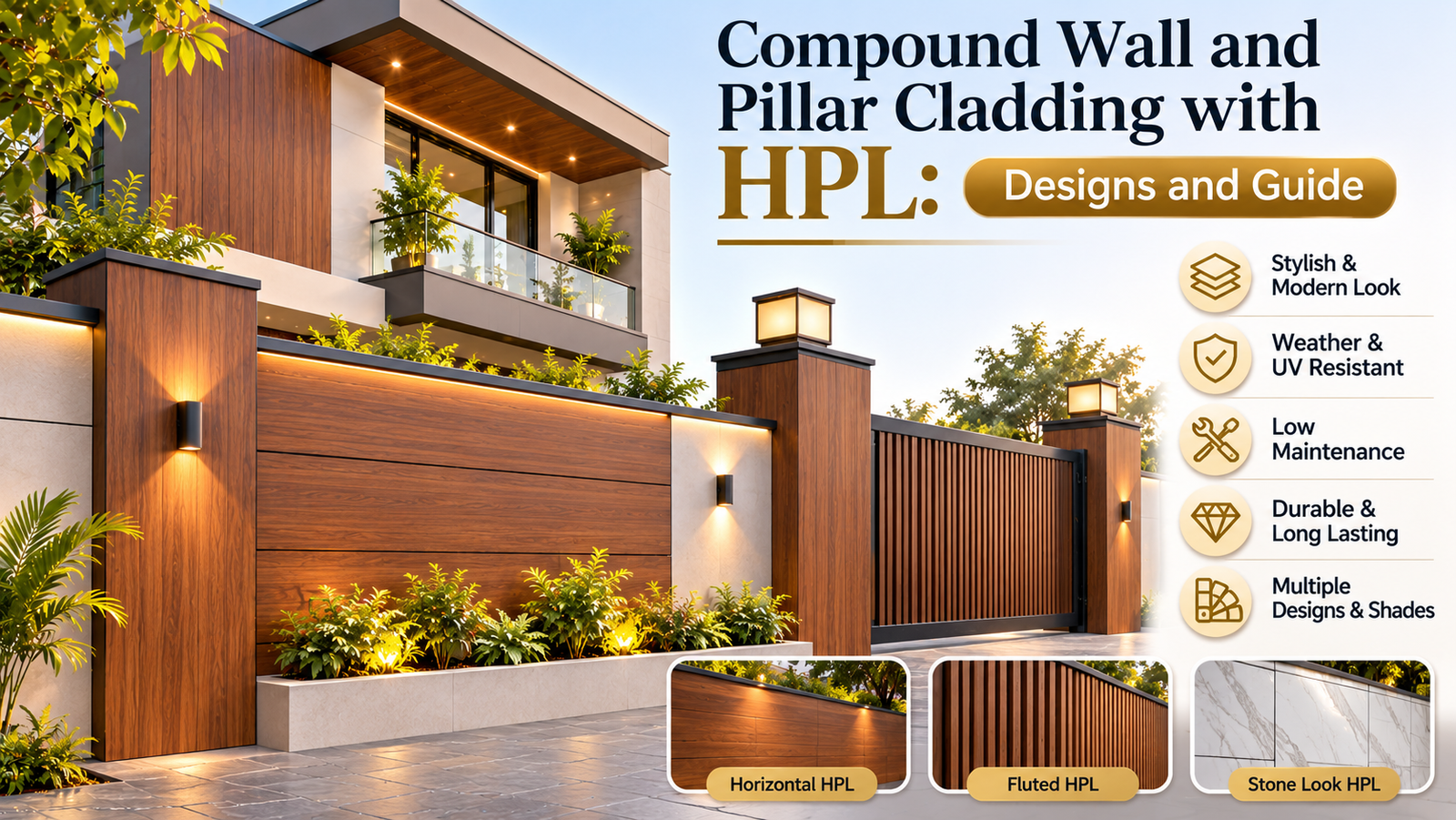
Your compound wall and gate pillars are the first thing anyone sees, long before they reach the front door. Yet they're usually just plastered and painted, and they fade, stain and crack faster than the house. HPL cladding fixes that for good.
Think about the last time you visited a new house. Before you saw the living room or even the front door, you saw the boundary wall, the gate and the two pillars on either side. That first glance shapes how the whole home feels.
Most compound walls in India are simply plastered and painted. Within a couple of monsoons, they show algae near the ground, rust streaks under the gate hinges, cracks at the pillar corners and faded paint. Cladding the compound wall and gate pillars with HPL keeps that first impression sharp for years.
Compound wall cladding is a decorative, protective layer fixed to a boundary wall and gate pillars. Exterior HPL works especially well here because it doesn’t absorb rain or ground moisture, isn’t eaten by termites, keeps its colour in the sun and comes in wood, stone and solid finishes. HPLMaker exterior sheets come in 8 × 4 ft and carry a 25-year warranty.
- Compound walls face rain, splash-back, ground damp, dust and knocks from vehicles.
- Painted plaster here needs frequent repainting; HPL just needs washing.
- Clad the gate pillars first for the biggest visual impact.
- Match the boundary finish to the house elevation so the frontage looks planned.
- Keep the cladding a little above ground level and seal the top edge.
Why Compound Walls Age So Quickly
A boundary wall gets a tougher life than most of the house. Rain splashes mud onto its lower part. Ground moisture creeps up from below. Sprinklers and car washing soak it regularly. Vehicles brush against the pillars while turning in. And it faces the street, so dust and pollution settle on it every day.
Paint can’t keep up with all of that. Most homeowners repaint their compound wall more often than the house, and still see it looking tired within a year.
8 Compound Wall and Pillar Design Ideas
1. Stone-finish gate pillars
Tall gate pillars in a light grey or sandstone finish look solid and premium. Add wall lights on the inner faces for a welcoming glow at night.
2. Wooden top band
Clad the top half of the compound wall in a wooden finish and leave the lower half in plaster or a darker solid colour. It looks warm and hides splash marks near the ground.
3. Full wooden boundary
A complete wooden-finish compound wall with horizontal joints is bold and modern, especially with a black or dark grey gate.
4. Matching the house elevation
If your house has a wooden balcony or a stone feature wall, use the same finish on the pillars. It ties the boundary to the house and makes the whole frontage look designed as one. See our balcony cladding ideas for inspiration.
5. Solid charcoal with lights
A matte charcoal compound wall with a row of small wall lights gives a sleek, contemporary look, especially for corner plots.
6. Name-plate pillar
Clad one pillar in a contrasting finish and mount your house name or number on it. The sealed HPL surface makes a clean, easy-to-maintain backdrop.
7. Two-tone split
Use a stone finish for the pillars and a wooden finish for the wall panels between them. The rhythm of pillar–panel–pillar looks especially good on long boundaries.
8. Gate and pillars together
Many owners clad the gate with HPL too, so the gate and pillars match perfectly. See our HPL gate page and modern HPL gate designs for ideas.

Why HPL Is a Smart Choice Here
It handles ground moisture. HPL absorbs almost no water, so damp from below and splash from rain don’t cause stains or swelling.
Termites leave it alone. Boundary walls touch soil and gardens, where termites are common. HPL isn’t a food source for them, unlike real wood.
It shrugs off dust. Street dust and pollution wash off the sealed surface with water and mild soap. Our HPL cladding maintenance tips explain the routine.
It takes knocks. Exterior compact HPL is dense and impact-resistant, so it handles the occasional brush from a car or bike better than plaster corners.
The colour stays. A UV-protective layer keeps the finish rich on sun-facing street walls.
Practical tip: Keep the bottom edge of the cladding about 100 to 150 mm above the ground or paving. This keeps it out of standing water and splash zones and makes cleaning easier.
Choosing Finishes for Your Frontage
| Your house style | Pillars | Compound wall | Gate |
|---|---|---|---|
| Modern white or grey | Charcoal solid | White plaster or light grey | Black metal or charcoal HPL |
| Warm contemporary | Light stone finish | Wooden band on top | Wooden-finish HPL |
| Classic villa | Sandstone finish | Beige plaster with stone coping | Dark wood finish |
| Minimal and bold | Wooden finish | Matte charcoal | Black metal |
For more help, read how to choose the right HPL shade for your exterior and browse the HPLMaker shade card.
How Compound Wall Cladding Is Installed
- Inspect the wall for cracks, loose plaster and damp near the base, and repair them first.
- Plan the layout around 8 × 4 ft sheets so joints line up with pillar edges and the gate.
- Fix an aluminium frame to the wall with anchors, leaving a small air gap behind the panels.
- Cut and fix the HPL panels, keeping the bottom edge above ground and leaving small expansion gaps.
- Wrap the pillar corners with clean edge trims or mitred joints for a sharp finish.
- Seal the top with a coping or cap so rain can’t get behind the cladding.
- Add lights and the name plate last, using the frame for neat cable routing.
Full details are on our HPL sheet installation page.
Planning your wall? Find out how many 8 × 4 ft HPL sheets you need in 30 seconds.
Open HPL Sheet CalculatorHow Much HPL Will You Need?
Measure the length and height of each wall section, and all four faces of each pillar (or the faces you want to clad). Subtract the gate opening. Add about 10 percent for cutting waste, more if you’re wrapping many pillar corners. Divide the total by 32 sq ft, the coverage of one 8 × 4 ft HPLMaker sheet.
For example, two pillars of 1.5 × 1.5 ft and 8 ft high, cladding all four faces, need 2 × 4 × 1.5 × 8 = 96 sq ft. With 10 percent wastage that’s about 106 sq ft, or 4 sheets.
Mistakes to Avoid
Cladding right down to the ground. Water and mud will sit on the bottom edge. Leave a gap.
Ignoring the gate hinges. Rust from old hinges can streak onto new cladding. Fix or replace rusty hardware before cladding.
Too many finishes. A boundary wall with four different finishes looks busy. Two is usually perfect.
Forgetting the inside face. If the compound wall is visible from your garden or sit-out, consider cladding the inner face too, at least on the pillars.
Lighting Your Compound Wall
Good lighting makes a clad frontage look premium at night and improves security.
- Wall lights on pillar faces frame the gate and light the house name.
- Linear up-lights at the base of a wooden or stone band highlight the texture.
- Spike lights in planters along the wall add a soft glow.
Plan the wiring with the cladding frame so cables stay hidden and protected.
Corner Plots and Long Boundaries
Corner plots have two street-facing walls, so the boundary is extra visible. Use the same finish on both sides and turn the corner with a clean pillar or an edge trim, so it reads as one continuous design.
On long boundaries, break the length with pillars every few metres and use a pillar–panel–pillar rhythm. This avoids a flat, monotonous wall and looks far more architectural.
Maintenance Routine
Because compound walls face the road, they collect more dust than the house. A quick wash with water and mild soap every month or two keeps HPL looking fresh. After the monsoon, check the bottom edge and coping for trapped debris or leaves. Avoid pressure washers set too close to joints and never use abrasive powders. Our HPL cladding maintenance tips explain the basics.
Planning Permission and Neighbours
Cladding an existing compound wall is usually a simple finishing job, but if the wall is shared with a neighbour, agree on the design and which face you’ll clad before work starts. In gated societies, check whether there are guidelines for frontage finishes. A short conversation early saves trouble later.
The Long-Term Picture
A painted boundary wall typically needs repainting every year or two to look fresh, plus repairs for cracks and stains. An HPL-clad wall needs washing, not painting. Over 10 to 15 years, that difference in upkeep, together with a frontage that keeps looking new, is why more homeowners are cladding their boundaries along with the house.
Frequently Asked Questions
What is the best cladding for a compound wall?
Exterior HPL is one of the best choices because it absorbs almost no water, isn’t eaten by termites, resists dust and knocks, and keeps its colour in the sun.
Can HPL be used on gate pillars?
Yes. Gate pillars are one of the most popular uses for HPL. Stone and wooden finishes are common, often with wall lights on the inner faces.
How high above the ground should cladding start?
Keeping the bottom edge about 100 to 150 mm above the ground or paving helps avoid standing water and splash marks.
Will HPL cladding hide cracks in my compound wall?
It will cover them visually, but cracks should be repaired first so the wall stays structurally sound and the frame anchors hold well.
How many HPL sheets do I need for two gate pillars?
Two 1.5 × 1.5 ft pillars, 8 ft high, clad on all four faces need about 96 sq ft, or 4 sheets of 8 × 4 ft with 10 percent wastage.
How long does HPL compound wall cladding last?
Exterior-grade HPL with UV protection is built for long outdoor life. HPLMaker exterior sheets carry a 25-year warranty.
Make a strong first impression
Get HPL shades for your compound wall, gate and pillars, plus a quote from the HPLMaker team.
WhatsApp UsView Shade Card