
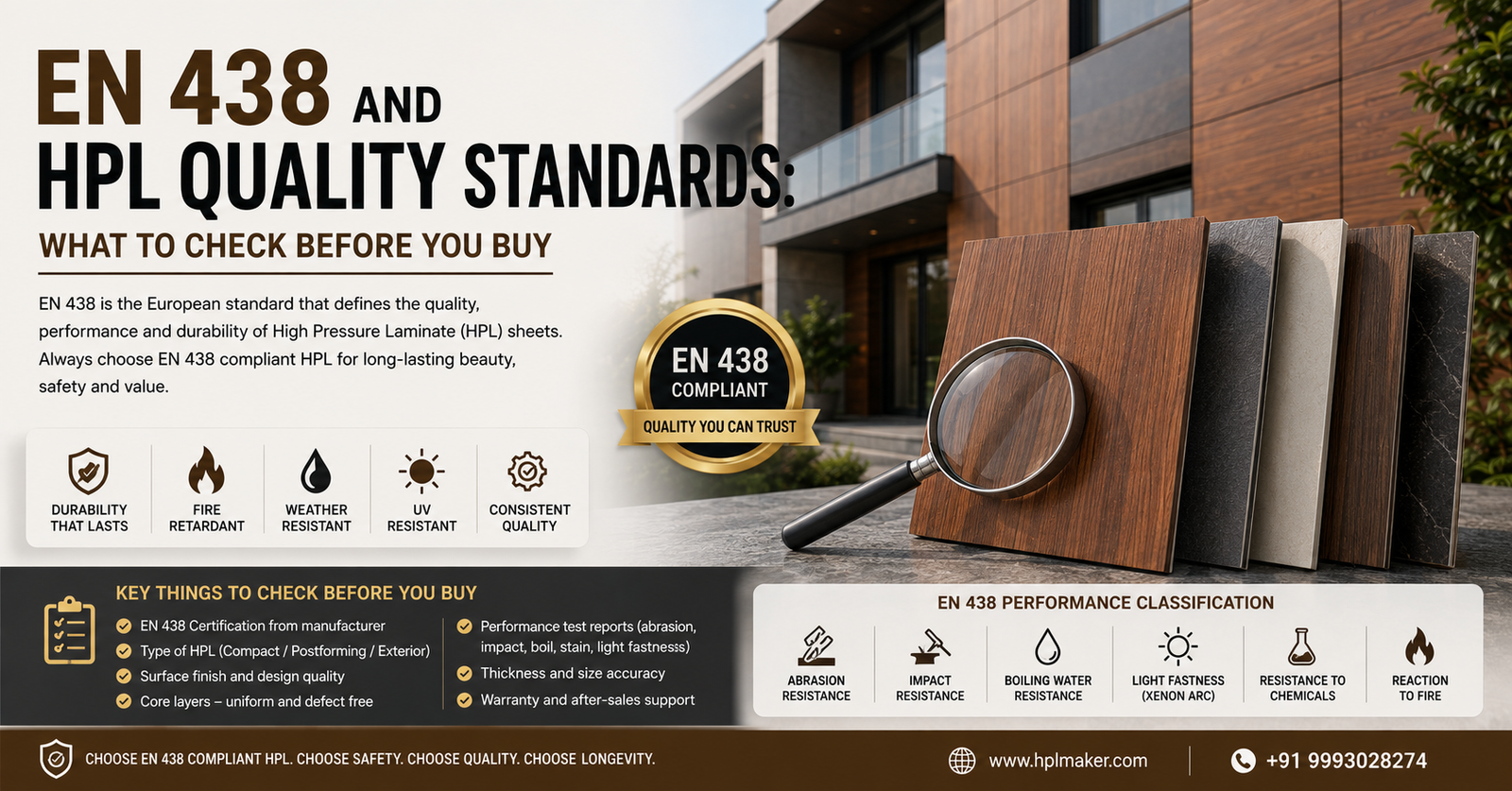
Quick answer: EN 438 is the European standard family for high pressure decorative laminates. It defines how HPL is tested for surface wear, impact, scratch, boiling water, dimensional stability, colourfastness and weathering. For exterior facade work, the compact exterior parts of the standard are the benchmark, and a credible supplier will share test reports for the exact product code you are buying.
Table of Contents
- What EN 438 Actually Covers
- The Test Properties That Matter Outdoors
- The Documents a Serious Supplier Will Provide
- Indian Standards and Site Reality
- Red Flags When Reading Certificates
- Frequently Asked Questions
What EN 438 Actually Covers
EN 438 is a multi-part standard that describes what high pressure laminate is, how it should be classified, and the laboratory methods used to test it. It is written for manufacturers and specifiers, and it is the single most useful reference for a buyer trying to separate marketing language from measurable performance.
The parts most relevant to a facade project are the ones dealing with test methods, general classification, and exterior-use compact laminate. When a supplier says a product is ‘EN 438 compliant’, the correct follow-up question is: compliant with which part, and can I see the report?
The Test Properties That Matter Outdoors
| Property | What it measures | Why it matters on a facade |
|---|---|---|
| Resistance to artificial weathering | Colour and gloss change after accelerated UV and moisture exposure | The single best predictor of how the shade will look in year five |
| Resistance to wet conditions | Behaviour after prolonged boiling water or humidity exposure | Monsoon and wind-driven rain performance |
| Dimensional stability | Movement between dry and humid states | Determines the joint width your facade needs |
| Impact resistance | Response to a falling ball or hard body strike | Ground floor, corridors, parking, school zones |
| Surface scratch and abrasion | Wear resistance of the decorative surface | Cleaning, dust abrasion, contact traffic |
| Flexural strength and modulus | Stiffness and bending capacity | Support spacing and wind load design |
| Resistance to staining | Reaction to common chemicals and pollutants | Urban pollution, bird droppings, cleaning agents |
The Documents a Serious Supplier Will Provide
- A technical datasheet for the exact product code, listing thickness, density, and tested properties with units.
- A test report from a recognised laboratory rather than an internal certificate with no methodology.
- A fire performance report if the building type demands it, naming the test method and result class.
- A written warranty stating the term, what is covered, what voids it, and the claim process.
- Installation guidelines with fixing spacing, joint widths and permitted fasteners.
- Care and maintenance instructions, which also define what cleaning agents will void the warranty.
If a supplier can produce all six for the product code on the quotation, you are dealing with a manufacturer. If they can only produce a glossy brochure, you are probably dealing with a trader who does not know the origin of the material.
Indian Standards and Site Reality
Indian projects reference a mix of Indian Standards, EN standards and client specifications. The National Building Code governs fire and life safety expectations for the building as a whole, while the facade material specification usually rides on EN 438 because it is the most complete laminate standard available.
In practice, a good project specification names three things: the standard the panel is tested to, the minimum thickness and grade, and the fixing system with its own approvals. Anything less leaves room for substitution on site.
Red Flags When Reading Certificates
- A certificate for a different thickness or a different product code than the one being supplied.
- A report dated many years ago with no batch traceability to current production.
- Results quoted without the test method – a number with no method behind it means very little.
- A ‘certificate’ issued by the seller to itself, with no laboratory named.
- Fire claims stated as a marketing phrase such as ‘fire proof’ rather than a tested classification.
- Warranty language that covers only manufacturing defect while excluding fading and delamination, the two things that actually go wrong outdoors.
Key Takeaways
- EN 438 is the reference standard family for high pressure laminate, including exterior compact grades.
- Weathering, wet conditions and dimensional stability are the tests that predict facade performance.
- Demand datasheets and lab reports for the exact product code, not generic brochures.
- Fire performance should be stated as a tested classification, never as a marketing phrase.
- A warranty that excludes fading and delamination is not really an exterior warranty.
Frequently Asked Questions
What is EN 438?
EN 438 is a European standard family covering high pressure decorative laminates. It defines classification and the laboratory test methods used to measure properties such as wear, impact, moisture behaviour, dimensional stability and weathering resistance.
Is EN 438 applicable in India?
It is not an Indian statutory requirement, but it is the most widely used technical reference for laminate specification worldwide and is routinely written into Indian architectural specifications for facade and cubicle work.
What certificates should I ask for when buying HPL?
Ask for the product datasheet, an independent laboratory test report for that product code, a fire performance report where the building demands it, a written warranty, installation guidelines and maintenance instructions.
Does a test certificate guarantee my panels are the same quality?
Only if the certificate is traceable to current production. Ask for batch details on delivery and keep a retained sample from the actual consignment so any later dispute has a physical reference.
Which EN 438 property predicts fading?
Resistance to artificial weathering is the closest laboratory proxy for real-world fading, because it exposes the surface to accelerated UV and moisture cycles and measures colour and gloss change.
Related Reading on HPL Maker
Talk to HPL Maker
HPL Maker is an Indian manufacturer of exterior-grade high pressure laminate with an industry-first live camera warranty of up to 25 years. Share your drawings or elevation photos and our team will suggest the right shade, thickness and fixing system for your project.
- Call / WhatsApp: +91 89824 90236
- Email: marketing@hplmaker.com
- Factory & Head Office: 124-126, Vrindavan Palace, Nipania Main Road, Vijay Nagar, Indore – 452010, Madhya Pradesh, India