
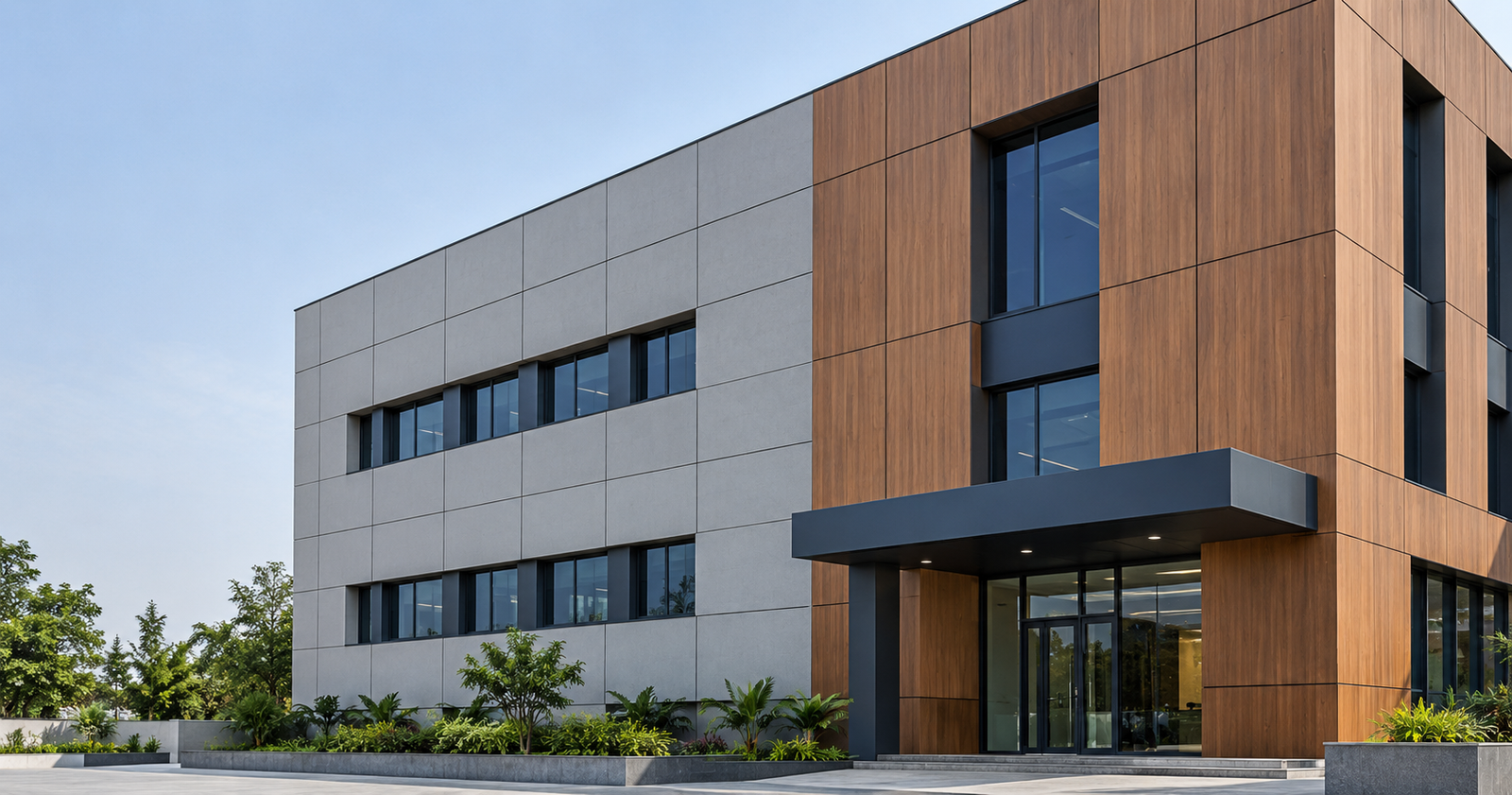
Walk past any new school, clinic, IT office or upgraded home in urban India and the flat matte board facade you see is almost always one of two materials: fibre cement board or HPL compact panel. They look similar on a drawing. They are completely different products, and the choice has real consequences for cost, finish quality and how the facade looks in year ten.
What Each Material Actually Is
Fibre cement board
A cementitious sheet, made from cement, cellulose fibre and mineral fillers, cured and cut to panel size. It is essentially a thin, reinforced cement product. It is mineral-based, which gives it inherent non-combustibility, and it is usually finished with a factory coating or painted on site.
HPL compact panel
Layers of kraft paper saturated with thermosetting resin, compressed under heat and high pressure into a solid, dense panel. Exterior grade adds a decorative layer and a UV-cured surface coating. It is organic-based, fully factory-finished, and the decorative surface is integral to the panel rather than applied to it.
Exterior-grade HPL is defined under EN 438-6, with Type EDF covering exterior decorative flame-retardant panels. The exterior range we manufacture at HPL Maker sits in this category, which is worth confirming on any quote — interior-grade laminate priced against exterior compact panel is not a like-for-like comparison.
Where They Genuinely Differ
Finish quality
This is the clearest difference. HPL arrives factory-finished with a sealed decorative surface — wood grain, stone, solid colour — that does not require painting and does not need refinishing. Fibre cement in most Indian applications is painted, either in factory or on site, and that paint layer has its own maintenance life.
If the project wants a convincing wood-look facade, HPL does it. Fibre cement does not.
Fire performance
Fibre cement wins here on principle. It is a mineral product, so it is non-combustible by nature rather than treated to be flame-retardant. HPL in FR grade performs well and achieves facade-standard classifications, but it remains an organic-based material.
On high-rise and high-occupancy buildings where the fire consultant is driving the specification, fibre cement has an argument that is hard to counter. On low and mid-rise work, FR-grade HPL with the right classification is routinely accepted.
Weight and handling
Fibre cement is heavier per square metre. That affects substructure design, lifting on upper floors and handling on site. HPL is lighter, which generally means a lighter frame and faster installation.
Cutting and site behaviour
Fibre cement cutting generates silica dust, which is a genuine occupational health matter requiring proper extraction and PPE. HPL cutting produces ordinary dust. On an occupied site — a working school or hospital — this difference affects how and when work can be done.
Fibre cement is also more brittle at edges and corners during handling. HPL is tougher in that respect.
Cost
Fibre cement is generally cheaper per square metre as a board. Once painting is added, and once repainting cycles are factored into a ten-year view, the gap narrows considerably. Exterior HPL carries a higher board cost but arrives finished.
Moisture behaviour
Both perform acceptably in a correctly built rainscreen. Fibre cement can absorb moisture and show efflorescence or surface staining if coating integrity is compromised. HPL has very low absorption but relies on sealed edges and proper cavity drainage.
What Matters More Than Either Choice
Here is the part that most project teams get wrong, and it applies identically to both materials.
In Indian board-cladding projects, the single most common cause of premature facade failure is not the board. It is the substructure — plain MS angle, welded up on site, given a coat of red-oxide primer, and then sealed inside a humid cavity where nobody will ever inspect it again.
A premium panel on a corroding frame fails. A modest panel on a properly specified galvanised or aluminium frame lasts. If a project has budget pressure, cutting the frame specification to afford a better board is exactly the wrong trade.
Choosing Between Them
Choose fibre cement when: non-combustibility is driving the specification, the facade will be painted anyway to a client colour, budget is the binding constraint, or the building height puts it in the strictest fire category.
Choose HPL when: the design calls for a wood, stone or specific decorative finish; the client wants no repainting cycle; weight or substructure loading is constrained; the site is occupied and dust control matters; or the facade needs to still look deliberate rather than merely maintained in year ten.
Many projects use both — fibre cement on back and service elevations, HPL on the public-facing front. That is a sensible allocation of budget rather than a compromise.
Frequently Asked Questions
Is fibre cement cheaper than HPL cladding?
As a board, generally yes. Once painting and repainting cycles are included over a ten-year period, the difference narrows substantially.
Which is better for fire safety?
Fibre cement is non-combustible by nature. FR-grade HPL achieves facade-standard fire classifications but is organic-based. On the strictest high-rise categories, fibre cement has the stronger position.
Can you get a wood finish on fibre cement?
Painted and printed wood effects exist, but they do not match the depth of a decorative HPL wood-grain surface with registered texture.
What causes most board facade failures in India?
Substructure corrosion, typically untreated or minimally primed mild steel framing sealed inside a humid cavity — not the board material itself.
Comparing board systems for a project? Contact HPL Maker for EN 438-6 documentation, fire classifications and substructure guidance.