
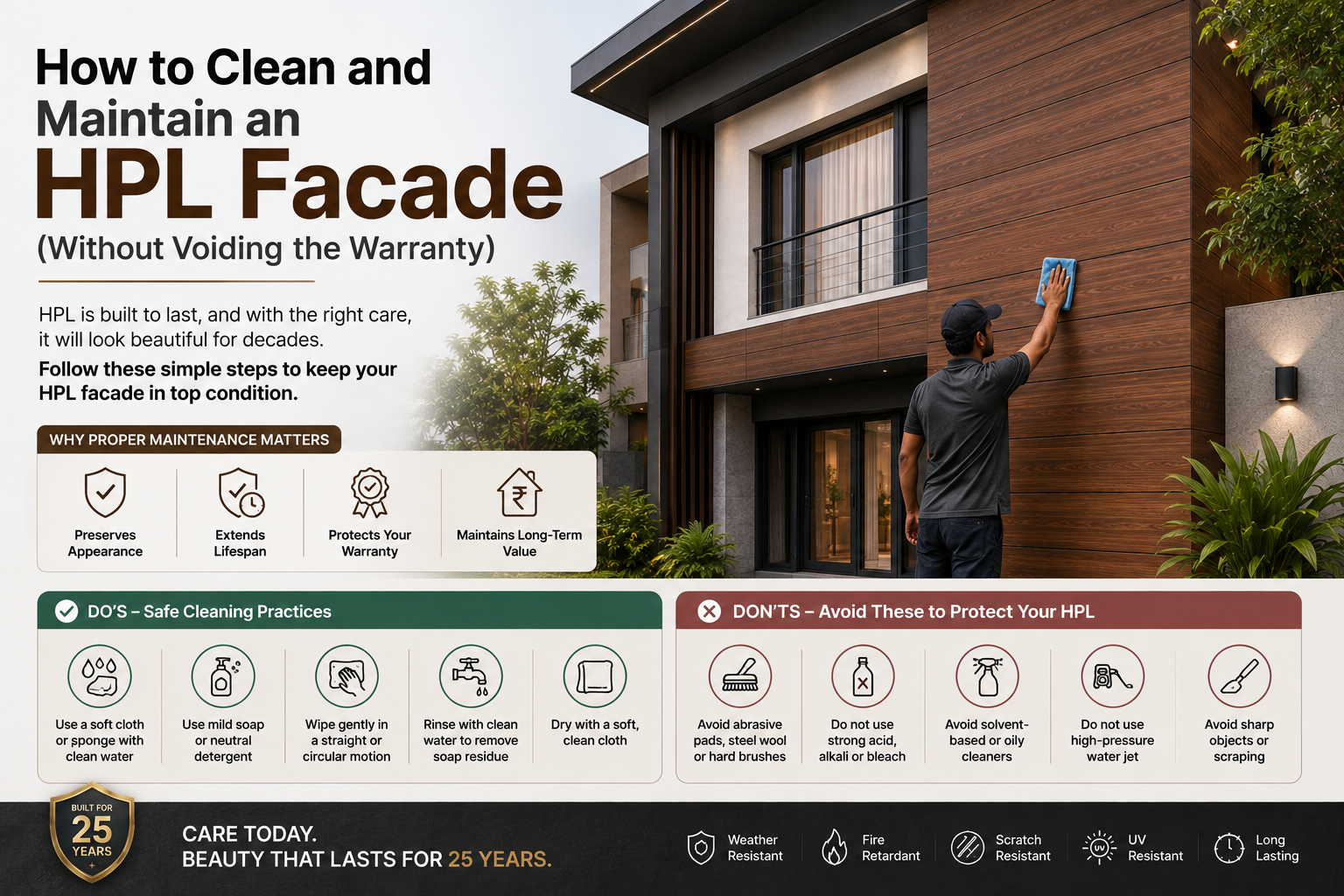
Quick answer: Clean HPL with warm water, a mild pH-neutral detergent and a soft cloth or sponge, then rinse and wipe dry. Avoid abrasive pads, scouring powder, strong solvents, acids and high-pressure jets aimed at joints. Twice a year is enough for most facades, more often in dusty or coastal locations.
Table of Contents
- Routine Cleaning: The Whole Method
- What Not to Use
- Removing Common Stains
- An Annual Facade Check
- Location-Based Frequency
- Frequently Asked Questions
Routine Cleaning: The Whole Method
This takes ten minutes per panel run and is the only thing most facades ever need.
- Rinse the surface with clean water to lift loose dust and grit before you touch it with a cloth. Dust dragged across a surface is what causes fine scratching.
- Wash with warm water and a mild pH-neutral detergent using a soft cloth, sponge or microfibre.
- Work top to bottom on one panel at a time so dirty water does not dry on cleaned areas.
- Rinse thoroughly with clean water so no detergent film remains to attract dust.
- Wipe dry with a soft cloth to avoid water spotting, particularly with hard water.
What Not to Use
| Avoid | Why |
|---|---|
| Scouring pads and steel wool | Permanently dulls the surface and creates micro-scratches that hold dirt |
| Abrasive powders and cream cleaners | Same effect – the shine never comes back |
| Strong acids and alkalis | Can attack the surface and discolour the decor layer |
| Aggressive solvents | May soften or haze the protective surface |
| High-pressure jet aimed at joints | Forces water into the cavity and can lift fixings |
| Wax and silicone polishes | Leave a film that attracts dust and shows every mark |
One practical note: cleaning agent damage is one of the few things that will void an exterior laminate warranty, so keep the manufacturer’s care sheet with your building documents and give a copy to whoever cleans the building.
Removing Common Stains
| Stain | First try | If that fails |
|---|---|---|
| Dust and general grime | Water and mild detergent | Repeat with a soft brush on textured finishes |
| Bird droppings | Soak with warm water, then wipe – never scrape dry | Mild detergent, soft cloth |
| Water and hard-water marks | Wipe dry after rinsing | Diluted white vinegar, then rinse well |
| Grease and oil splashes | Mild detergent | A little isopropyl alcohol on a cloth, then rinse |
| Adhesive residue and film marks | Warm soapy water | Manufacturer-approved cleaner only, test first |
| Graffiti | Contact the manufacturer before trying anything | Approved graffiti remover, spot-tested in a hidden area |
Always test any stronger cleaner on a concealed panel or an offcut first, and rinse fully afterwards.
An Annual Facade Check
Cleaning keeps it looking good. This checklist keeps it safe and watertight.
- Inspect fixings for any that have loosened, backed out or pulled through.
- Check joint widths are still even and no panel has shifted.
- Confirm the cavity is open at base and head, and clear the insect mesh of leaves and dust.
- Look for water staining below windows and copings, which points to a flashing issue rather than a panel issue.
- Check the sub-frame for corrosion at any exposed bracket, especially in coastal cities.
- Photograph the elevation each year from the same position – a simple record makes any change obvious.
Location-Based Frequency
| Location | Suggested cleaning frequency |
|---|---|
| Low-dust residential area | Once a year |
| Urban roadside or commercial frontage | Twice a year |
| Coastal city with salt-laden air | Three to four times a year, rinse focus |
| Industrial zone | Quarterly |
| Pre-monsoon and post-monsoon | Always worth one clean either side |
Key Takeaways
- Rinse first, then wash with mild pH-neutral detergent and a soft cloth.
- Never use abrasives, strong solvents, acids or high-pressure jets at joints.
- Test any stronger stain treatment on a concealed area first.
- Do an annual check of fixings, joints, cavity openings and sub-frame corrosion.
- Coastal and industrial locations need cleaning three to four times a year.
Frequently Asked Questions
How do I clean an HPL sheet?
Rinse off loose dust, wash with warm water and a mild pH-neutral detergent using a soft cloth or sponge, rinse thoroughly and wipe dry. This handles the vast majority of dirt on an exterior facade.
Can I pressure wash HPL cladding?
Light pressure washing at a distance can be acceptable on the panel face, but never aim a high-pressure jet directly at joints or panel edges because it can force water into the cavity and disturb fixings. Manual washing is safer.
What cleaners will damage HPL?
Abrasive pads and powders, strong acids and alkalis, aggressive solvents and wax or silicone polishes. These can dull, haze or discolour the surface, and cleaning damage is typically excluded from warranty cover.
How often should an HPL facade be cleaned?
Once a year in low-dust residential areas, twice a year on urban frontages, and three to four times a year in coastal or industrial locations. A clean before and after monsoon is a good default.
Does HPL need repainting or resealing?
No. The colour and protective surface are part of the pressed panel, not a coating applied on top, so there is no repainting or resealing cycle – which is the main reason HPL facades cost so little to maintain.
Related Reading on HPL Maker
Talk to HPL Maker
HPL Maker is an Indian manufacturer of exterior-grade high pressure laminate with an industry-first live camera warranty of up to 25 years. Share your drawings or elevation photos and our team will suggest the right shade, thickness and fixing system for your project.
- Call / WhatsApp: +91 89824 90236
- Email: marketing@hplmaker.com
- Factory & Head Office: 124-126, Vrindavan Palace, Nipania Main Road, Vijay Nagar, Indore – 452010, Madhya Pradesh, India