
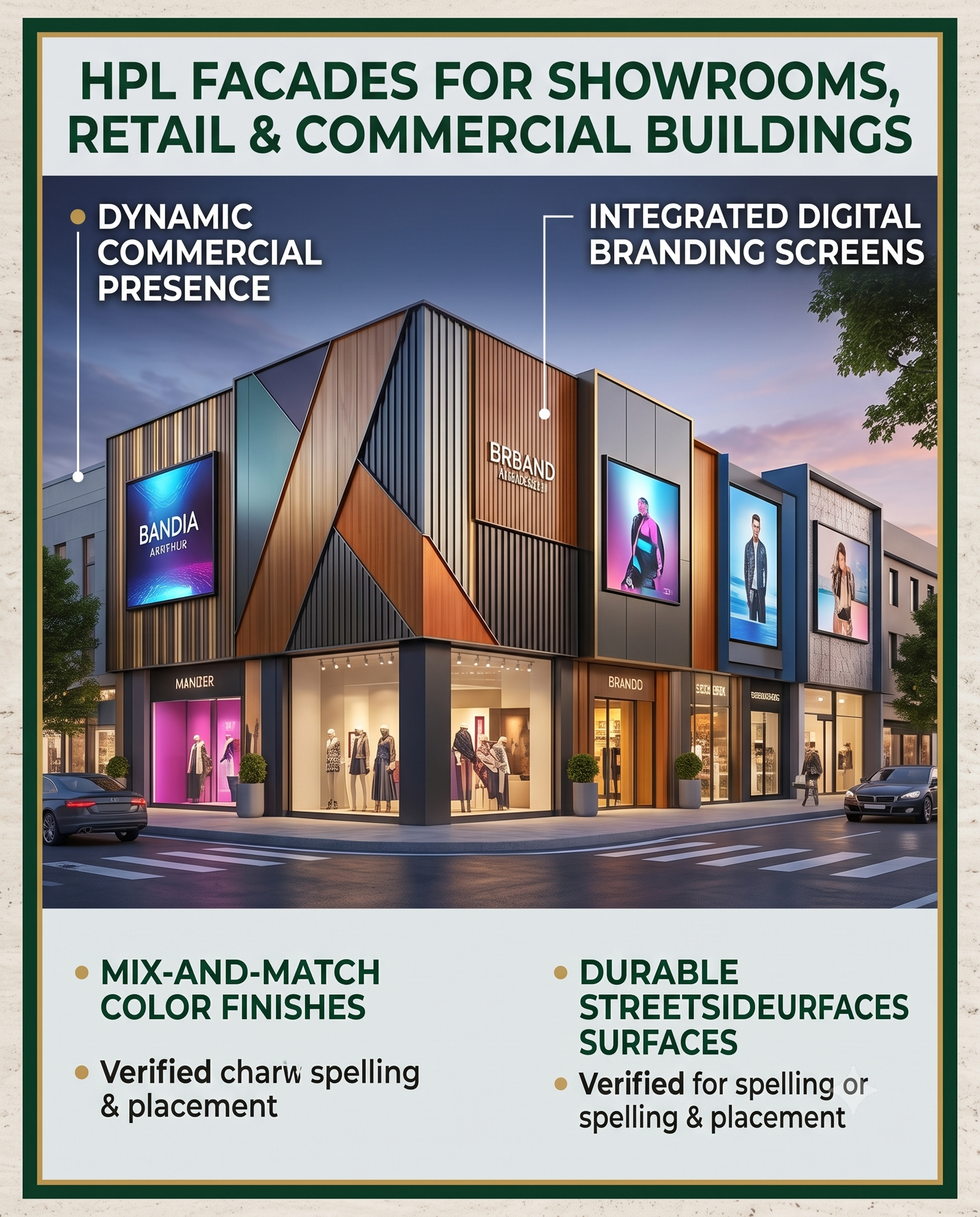
Quick answer: HPL suits commercial and retail facades because panels can be produced in consistent brand shades across multiple locations, installed quickly on a dry sub-frame without wet trades, cut precisely for signage integration, and cleaned rather than repainted through the life of the lease.
Table of Contents
- What Commercial Facades Actually Need
- Why Dry Construction Wins on Programme
- Integrating Signage and Lighting
- Sector Applications
- Multi-Location Rollout Advice
- Frequently Asked Questions
What Commercial Facades Actually Need
- Brand consistency – the same shade in Indore, Jaipur and Pune, not three approximations.
- Speed – store openings are fixed dates, and facade work sits at the end of the programme.
- Signage integration – logos, lightboxes and lettering need clean, precise mounting.
- Low maintenance – most retail units are leased, and nobody wants to repaint a facade on a five-year lease.
- Impact tolerance at street level, where vehicles, trolleys and pedestrians make contact.
- Night appearance, because a large share of retail footfall happens after dark.
Why Dry Construction Wins on Programme
HPL cladding is a dry system. Brackets, sub-frame, panels, done. There is no curing time, no wet plaster, no waiting for paint to dry between coats, and work can continue in weather that would stop a painting crew entirely.
On a typical showroom refit that difference can be one to two weeks of programme, and on a monsoon-season opening it can be the difference between opening on time and not opening at all.
Integrating Signage and Lighting
- Set out the panel grid and the signage position together, so no fixing lands where a logo needs to sit.
- Use CNC cutting for precise letter apertures and lightbox openings rather than site cutting.
- Round the internal corners of every rectangular aperture to prevent cracking.
- Plan cable routes through the ventilated cavity, with sealed penetrations rather than improvised holes.
- Consider a dark panel behind halo-lit lettering; the contrast at night is significantly stronger.
- Keep an access strategy for lightbox servicing – a removable panel section beats cutting a finished facade later.
Sector Applications
| Business type | Typical use | Design emphasis |
|---|---|---|
| Car showrooms | Full facade plus service centre | Brand shade consistency, large clean panels |
| Fashion retail | Storefront surround and fascia | Texture and lighting, frequent refresh capability |
| Banks and finance | Facade and ATM lobby | Solid neutral tones, secure impact zones |
| Restaurants and QSR | Facade, canopy soffit, outdoor seating | Warm tones, grease-resistant cleanable surfaces |
| Offices and IT parks | Full envelope with fire grade | Fire retardant, large-format panels |
| Malls | Anchor frontages and internal shopfronts | Coordinated palette across tenants |
Multi-Location Rollout Advice
Chains have a specific problem that one-off buildings do not: repeatability across sites and across time.
- Fix the brand shade against a physical control sample retained centrally, not against a printed colour code.
- Order in consolidated batches for multiple sites where the programme allows, so shade matching is inherent.
- Maintain central spare stock per shade so a damaged panel in one city does not become a facade mismatch.
- Standardise the sub-frame and panel module so local contractors follow one repeatable detail.
- Document the specification – grade, thickness, fire class, fixing – and issue it as a rollout standard.
HPL Maker supplies commercial rollouts from its Indore manufacturing base with local support across India, and can hold shade consistency across phased projects when the requirement is planned in advance.
Key Takeaways
- Dry cladding installation protects fixed store-opening deadlines, including through monsoon.
- Set out panel grid and signage positions together to avoid fixing clashes.
- CNC-cut apertures with radiused corners for lettering and lightboxes.
- Retain a central control sample and spare stock for multi-location brand consistency.
- Document grade, thickness, fire class and fixing as a rollout standard.
Frequently Asked Questions
Why is HPL used for showroom facades?
It offers consistent brand shades across multiple locations, installs quickly as a dry system without wet trades, integrates precisely with signage, and needs only washing instead of repainting through the lease.
How fast can an HPL facade be installed?
Once the sub-frame is up, panel fixing moves quickly and is not weather dependent in the way painting is. On a typical showroom refit this can save one to two weeks against a painted finish.
Can signage be mounted on HPL panels?
Yes. Apertures for lettering and lightboxes are best CNC cut with radiused internal corners, and cabling can be routed through the ventilated cavity with properly sealed penetrations.
Can the same HPL shade be matched across multiple cities?
Yes, when planned. Retain a central physical control sample, consolidate orders into common batches where possible, and hold central spare stock so later repairs match the original rollout.
Do commercial buildings need fire retardant HPL?
Multi-tenant offices, malls and taller commercial buildings generally do. Confirm the requirement with the building’s fire consultant and obtain the tested classification for the exact product code being supplied.
Related Reading on HPL Maker
Talk to HPL Maker
HPL Maker is an Indian manufacturer of exterior-grade high pressure laminate with an industry-first live camera warranty of up to 25 years. Share your drawings or elevation photos and our team will suggest the right shade, thickness and fixing system for your project.
- Call / WhatsApp: +91 89824 90236
- Email: marketing@hplmaker.com
- Factory & Head Office: 124-126, Vrindavan Palace, Nipania Main Road, Vijay Nagar, Indore – 452010, Madhya Pradesh, India