
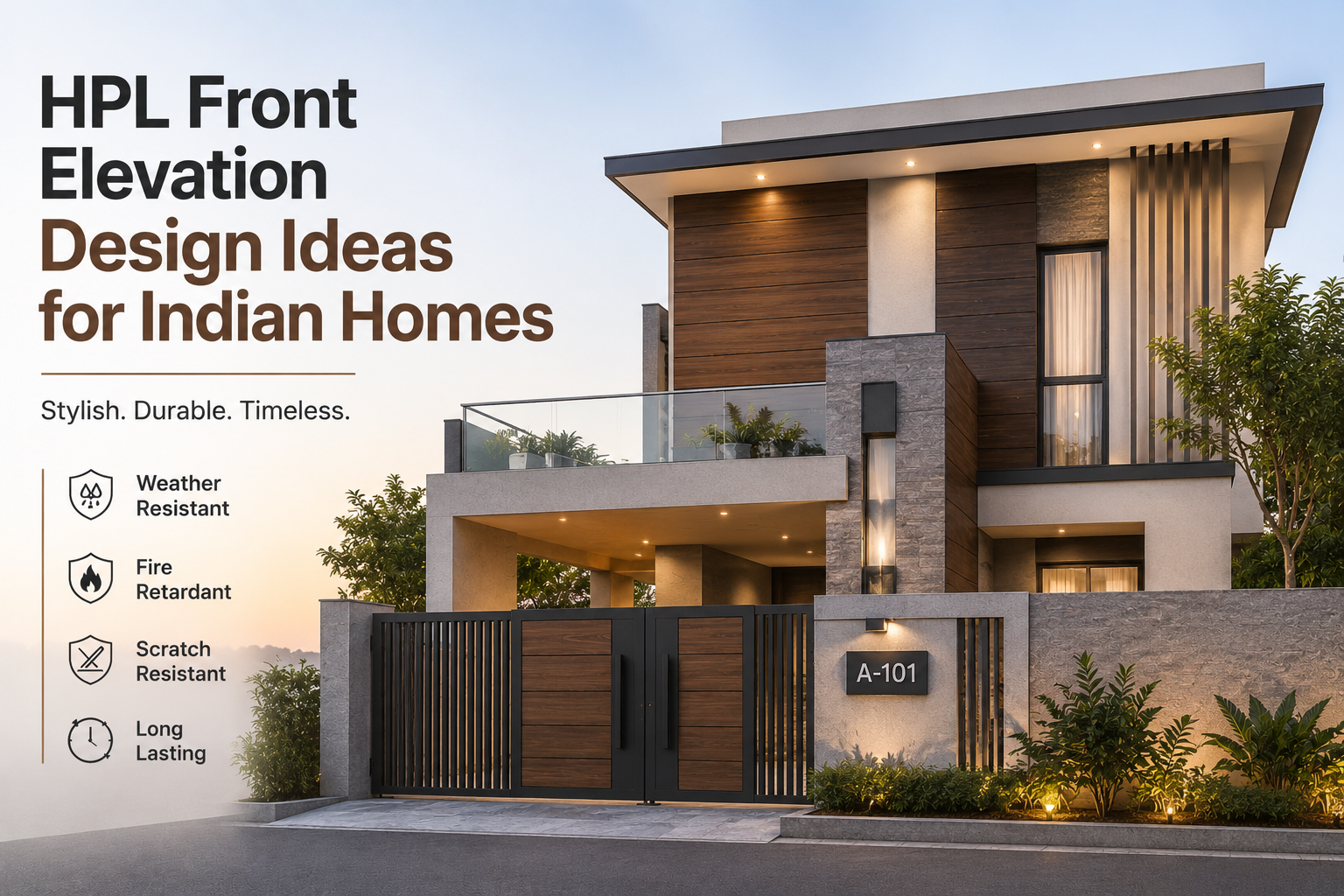
Quick answer: The most effective HPL elevation ideas for Indian homes combine a warm wood-finish base with a neutral solid tone, use vertical or horizontal banding to control proportion, and add depth through fins, screens and reveal shadows. Keep the palette to two or three shades and let panel joints form a deliberate grid rather than a random one.
Table of Contents
- Start With Proportion, Not With Shade
- Fifteen HPL Elevation Ideas That Work
- Choosing Shades for Indian Light
- Detailing That Separates Good From Ordinary
- Frequently Asked Questions
Start With Proportion, Not With Shade
The most common elevation mistake is choosing a beautiful wood decor and then applying it everywhere, which flattens the facade into a single brown box. Good elevations work first in proportion and only then in colour.
A reliable formula for an Indian home: one dominant neutral covering roughly 60 percent, a warm wood or textured tone for around 30 percent placed where people look – entrance, balcony, staircase tower – and a dark accent for the remaining 10 percent to sharpen edges and reveals.
Fifteen HPL Elevation Ideas That Work
Volume and massing
- Wood band over neutral base – a full-height warm wood strip through the double-height entrance, with a light grey or off-white field around it.
- Framed box – clad a projecting balcony volume entirely in one dark shade so it reads as a separate mass.
- Staircase tower feature – the vertical circulation clad in a contrasting tone, which naturally suits its proportions.
- Floating parapet band – a single deep horizontal band at roof level to give the house a defined top edge.
- Plinth in dark stone finish – a darker HPL at ground level where splash and dirt collect, which also hides them.
Depth and shadow
- Vertical fins in HPL over a dark backing, giving strong shadow lines that change through the day.
- Louvre screens for privacy over staircase windows and utility balconies, with airflow retained.
- Recessed reveals around windows using a darker shade to make the openings read deliberately.
- Stepped panel planes where two sections of the facade sit at slightly different depths on the same sub-frame.
- Jaali-style perforated panels in CNC-cut HPL for a contemporary reading of a traditional Indian device.
Material mixing
- HPL with exposed concrete – warm laminate against grey concrete is a reliably strong pairing.
- HPL with stone base – natural stone at plinth level and HPL above, keeping the heavy material low.
- HPL with glass railing – clean balconies where the panel forms the solid, glass forms the void.
- HPL soffit under a projection – continuing the wood tone across the underside of a cantilever adds significant richness.
- HPL gate and boundary wall matched to the house, which pulls the whole plot together visually.
Choosing Shades for Indian Light
Indian sunlight is intense and warm, which changes how shades read compared with a European catalogue photograph.
| Shade family | How it behaves outdoors | Best used for |
|---|---|---|
| Warm teak and walnut | Rich and inviting, hides dust well | Entrance features, soffits, gates |
| Grey oak and ash | Contemporary, cooler, reads clean | Large fields, mixed with concrete |
| Off-white and light grey | Bright but shows dust in urban locations | Upper floors, background field |
| Charcoal and black | Very sharp edges, high surface temperature | Accents, reveals, fins – use sparingly on large areas |
| Stone and concrete finishes | Neutral, textural, very forgiving | Plinths and large field areas |
Detailing That Separates Good From Ordinary
- Align panel joints with window edges so the grid reads intentional rather than accidental.
- Keep the joint width identical across the whole elevation – inconsistency is what the eye notices first.
- Plan lighting with the cladding, not after it. A grazing light along a fin wall transforms an elevation at night.
- Detail the corner properly with a mitre or an angle profile; a badly finished corner undoes a good facade.
- Continue the cladding into the reveal at least a little, so you never see raw plaster edge at an opening.
- Order one extra sheet per shade and store it, so a future repair matches.
Key Takeaways
- Design proportion first: roughly 60 percent neutral, 30 percent warm accent, 10 percent dark.
- Depth from fins, screens and reveals matters more than shade variety.
- Warm wood tones hide dust; light shades show it in urban locations.
- Align panel joints with window edges and keep joint widths identical throughout.
- Extend the palette to gate, boundary wall and soffit to tie the plot together.
Frequently Asked Questions
Which HPL shade is best for a house front elevation?
A warm wood tone for the entrance and feature areas with a neutral grey or off-white field is the most reliable combination in Indian light. Restrict dark charcoal and black to accents, reveals and fins.
Can HPL be used for the whole front elevation?
Yes. Exterior-grade HPL is designed for full facade application on a ventilated sub-frame, and many Indian homes clad the entire street-facing elevation including balconies, soffits and the boundary gate.
How many shades should a home elevation use?
Two or three works best. More than three usually makes the facade look restless, and it also complicates ordering, batch matching and future repairs.
Does dark HPL get too hot?
Dark surfaces reach higher surface temperatures in direct sun, which is why they are best used as accents rather than across large west-facing areas. The ventilated cavity behind a rainscreen substantially reduces how much of that heat reaches the wall.
Can HPL match my existing stone or concrete finish?
Usually yes. Modern HPL shade cards include stone, marble and concrete decors specifically so cladding can sit alongside natural materials without clashing. Always compare physical samples in daylight rather than screen images.
Related Reading on HPL Maker
Talk to HPL Maker
HPL Maker is an Indian manufacturer of exterior-grade high pressure laminate with an industry-first live camera warranty of up to 25 years. Share your drawings or elevation photos and our team will suggest the right shade, thickness and fixing system for your project.
- Call / WhatsApp: +91 89824 90236
- Email: marketing@hplmaker.com
- Factory & Head Office: 124-126, Vrindavan Palace, Nipania Main Road, Vijay Nagar, Indore – 452010, Madhya Pradesh, India