
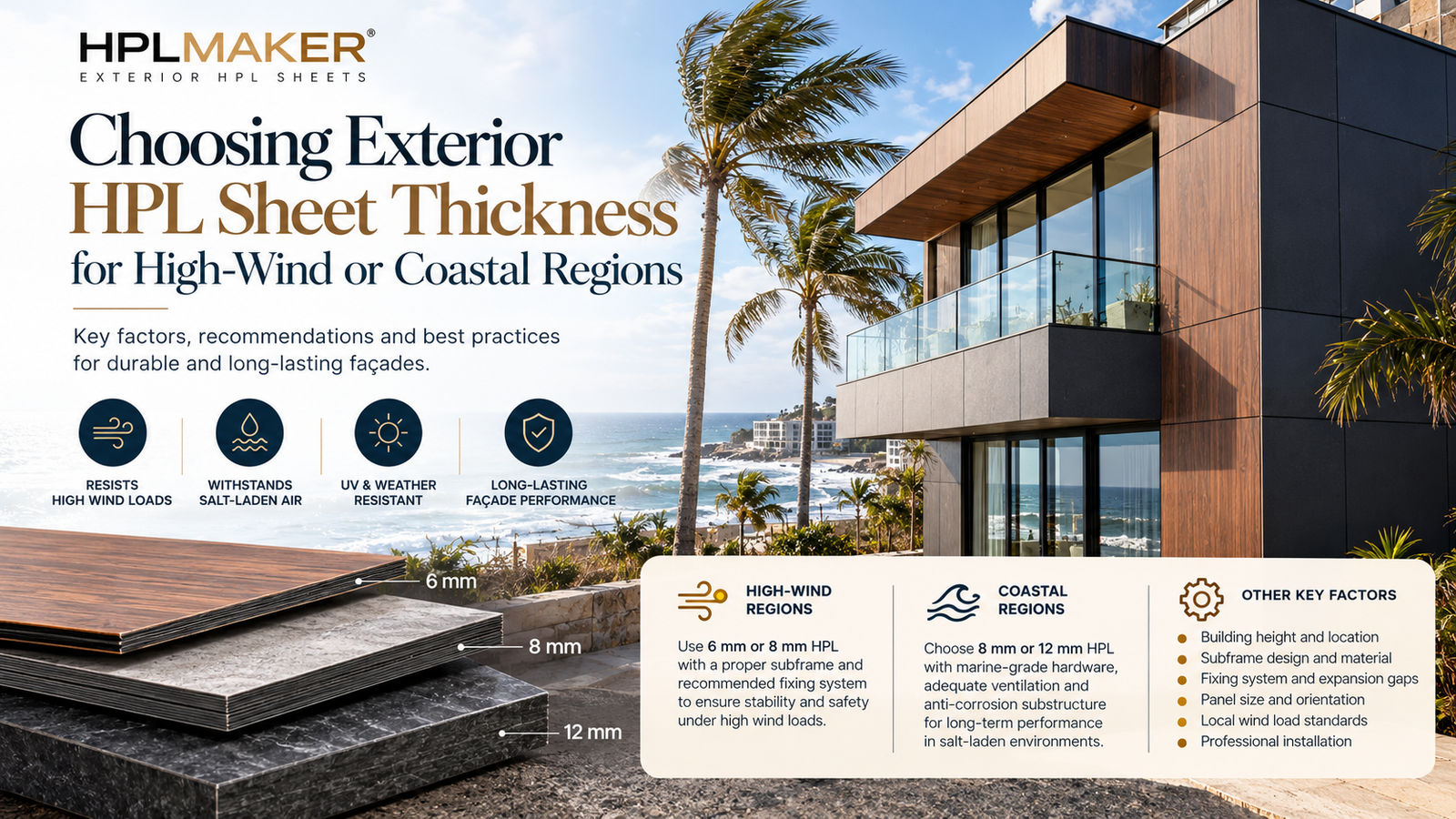
A panel that performs well in a sheltered inland location isn’t automatically the right specification for a coastal high-rise or a site that regularly sees strong seasonal winds. Thickness and fixing system both need to account for the actual conditions the facade will face.
Why wind load matters more than people expect
Wind doesn’t just push on a facade — it creates suction pressure on the leeward side and turbulent loading at corners and edges, which is where panel failure is most likely if the specification is undersized. Taller buildings and more exposed sites see meaningfully higher wind loads than a sheltered low-rise inland building, and panel thickness combined with fixing point spacing needs to be calculated against that, not assumed.
Coastal-specific considerations, beyond just wind
Salt-air exposure doesn’t affect the HPL panel material itself the way it affects metal cladding or fixing hardware — but it does mean fixing hardware and substructure components need to be specified in a genuinely corrosion-resistant grade for coastal projects specifically, not a standard inland-spec fixing system.
How thickness gets decided properly
A proper specification takes building height, local wind zone classification, panel span between fixing points, and site exposure into account — this is engineering, not guesswork, and it’s why a legitimate exterior HPL supplier should be able to talk through these factors rather than just quoting a default thickness regardless of project specifics.
What happens when this gets skipped
Under-specified panels in high-load conditions are more likely to show stress at fixing points over time, in the worst case leading to panel movement or failure in extreme wind events. This isn’t a common outcome with a properly specified system, but it’s exactly the kind of risk that proper thickness and fixing-point specification exists to manage.
Who should be involved in this decision
For any project beyond a straightforward low-rise inland home, this is worth a conversation with a structural or facade consultant alongside the HPL supplier, not a decision made purely on catalogue browsing. HPLMaker’s technical team supports exactly this kind of project-specific specification conversation for architects and developers.
FAQ
Does a coastal project always need thicker panels than an inland one?
Not automatically thickness alone — fixing system and hardware grade often matter as much as panel thickness for coastal-specific durability.
Is there a simple way to check my project’s wind zone classification?
Local building codes and structural consultants typically have this on hand for a specific site; it’s a standard input to any properly engineered facade specification.
Can the same panel thickness be used throughout a tall building, or does it vary by floor?
Wind loading can vary meaningfully by height and location on a building, so thickness and fixing density sometimes vary across a facade rather than being uniform throughout — a project-specific specification would address this.