
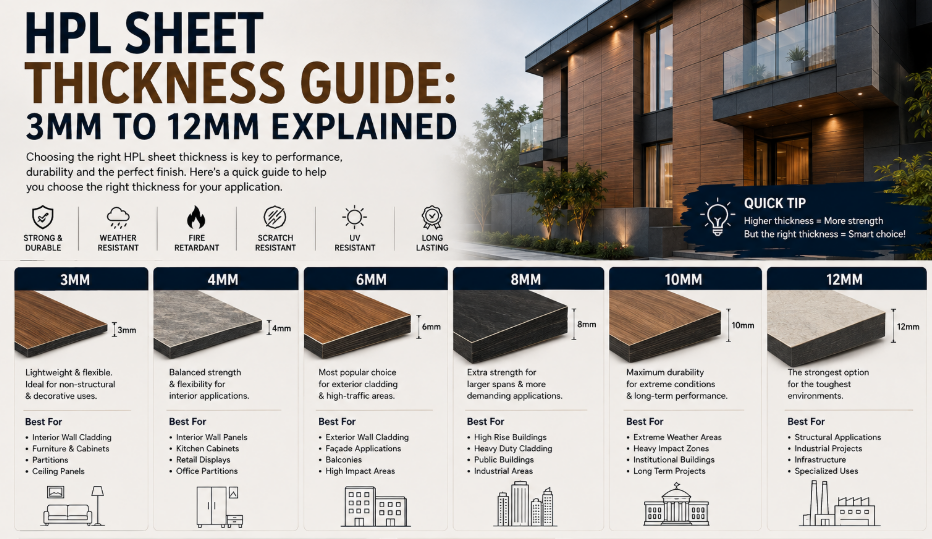
Quick answer: For exterior facades in India, 6mm HPL is the standard specification and 8mm is used on tall, wind-exposed or wide-span elevations. 3mm and 4mm suit interiors, soffits and light cladding. 10mm and 12mm compact laminate is used for self-supporting elements such as toilet cubicles, lockers and worktops.
Table of Contents
- Why Thickness Is the First Decision, Not the Last
- HPL Thickness Chart by Application
- How to Choose the Right Thickness for Your Project
- Weight: The Number Everyone Forgets
- Common Thickness Mistakes on Indian Sites
- Frequently Asked Questions
Why Thickness Is the First Decision, Not the Last
Designers usually pick the shade first and the thickness at the end, which is backwards. Thickness determines how far the panel can span between supports, how much sub-frame steel or aluminium the project needs, how the panel behaves in wind, and roughly half the material cost. Choose it early and the rest of the facade detailing falls into place.
The relationship is simple: a thicker panel is stiffer, so it can bridge a wider gap between framing members. That means fewer verticals, less aluminium, and faster fixing – which is why an 8mm panel is sometimes cheaper on an installed basis than a 6mm panel with a tighter grid.
HPL Thickness Chart by Application
| Thickness | Best suited for | Typical support spacing | Character |
|---|---|---|---|
| 3mm | Interior wall panels, furniture facing, signage, lift lobbies | 400 – 500mm | Light, easy to handle, needs continuous backing outdoors |
| 4mm | Soffits, balcony undersides, sheltered cladding, ceilings | 500 – 600mm | Good balance for protected exterior areas |
| 6mm | Standard exterior facade and wall cladding | 600 – 700mm | The workhorse thickness for Indian elevations |
| 8mm | Tall facades, wind-exposed elevations, wide bays | 700 – 900mm | Stiffer, fewer frame members, higher panel cost |
| 10mm | Semi self-supporting partitions, heavy-duty cladding | 900mm+ | Approaching compact laminate behaviour |
| 12mm | Toilet cubicles, lockers, lab tops, benches | Self-supporting | Full compact laminate, no backing needed |
How to Choose the Right Thickness for Your Project
- Start with exposure. Fully exposed elevation, high wind zone or a building above four floors pushes you towards 8mm. A sheltered courtyard wall is comfortable at 6mm.
- Check the panel size you want. Large uninterrupted panels need more stiffness. If your elevation design calls for tall vertical panels with minimal joints, go thicker.
- Look at the sub-frame budget. Aluminium is expensive. Sometimes 8mm panels on a wider grid cost less overall than 6mm on a tighter one.
- Consider contact and abuse. Ground floor, school corridors, hospital circulation and parking areas benefit from extra thickness even where wind does not demand it.
- Confirm the fixing method. Rivet-fixed and undercut-anchor systems have minimum thickness requirements; an undercut anchor cannot be used in a thin panel.
Weight: The Number Everyone Forgets
HPL has a density of roughly 1.35-1.45 g/cm3. That makes a 6mm sheet approximately 8-8.7 kg per square metre, and an 8mm sheet around 11 kg per square metre. Multiply that across a 500 square metre facade and you are adding four to five tonnes of dead load to the building envelope.
This is not a problem – it is simply information the structural consultant needs before brackets are anchored. Facade failures rarely come from the panel; they come from an anchor specified for a lighter material.
Specify the panel, then design the frame for the panel. Never the other way round.
Common Thickness Mistakes on Indian Sites
- Using 3mm exterior on an open elevation because it was cheaper, then watching it bow between supports within one summer.
- Buying a nominal 6mm sheet that measures 5.4mm – always check with a calliper on delivery.
- Keeping the 6mm sub-frame grid but switching to 4mm panels mid-project to save money.
- Using standard exterior HPL where a compact laminate cubicle panel was required, so the panel needs a backing frame that was never budgeted.
- Ignoring thickness tolerance at joints, which produces a visibly uneven shadow line across the facade.
Key Takeaways
- 6mm is the default exterior facade thickness in India; 8mm for tall or wind-exposed elevations.
- 3mm and 4mm belong indoors, in soffits and in sheltered cladding.
- 10mm and 12mm compact laminate is self-supporting and used for cubicles, lockers and worktops.
- Thicker panels span further, which can reduce total sub-frame cost.
- Always verify actual thickness with a calliper against what was quoted.
Frequently Asked Questions
Which HPL thickness is best for exterior walls?
6mm exterior-grade HPL is the standard choice for most Indian facades. Move to 8mm for buildings above four floors, high wind zones, coastal exposure or where the design calls for large panels with fewer joints.
Can I use 3mm HPL outside?
Only in sheltered positions with continuous backing, such as a protected soffit or a covered corridor. On an open elevation, 3mm is too flexible and tends to bow between supports under thermal movement and wind load.
What is the weight of a 6mm HPL sheet?
Roughly 8 to 8.7 kg per square metre, so a standard 8ft x 4ft sheet weighs approximately 24-26 kg. Confirm exact figures with the manufacturer’s technical datasheet for the grade you are buying.
What is the difference between 12mm HPL and compact laminate?
They are the same family. Compact laminate is simply HPL made thick enough – typically 10mm and above – to be self-supporting, which is why it is used for toilet cubicles, lockers and worktops without any backing board.
Does thicker HPL last longer?
Not directly. Longevity comes from the resin system and the UV-protected exterior surface, not from thickness. What extra thickness gives you is stiffness, impact resistance and wider spans.
Related Reading on HPL Maker
Talk to HPL Maker
HPL Maker is an Indian manufacturer of exterior-grade high pressure laminate with an industry-first live camera warranty of up to 25 years. Share your drawings or elevation photos and our team will suggest the right shade, thickness and fixing system for your project.
- Call / WhatsApp: +91 89824 90236
- Email: marketing@hplmaker.com
- Factory & Head Office: 124-126, Vrindavan Palace, Nipania Main Road, Vijay Nagar, Indore – 452010, Madhya Pradesh, India