
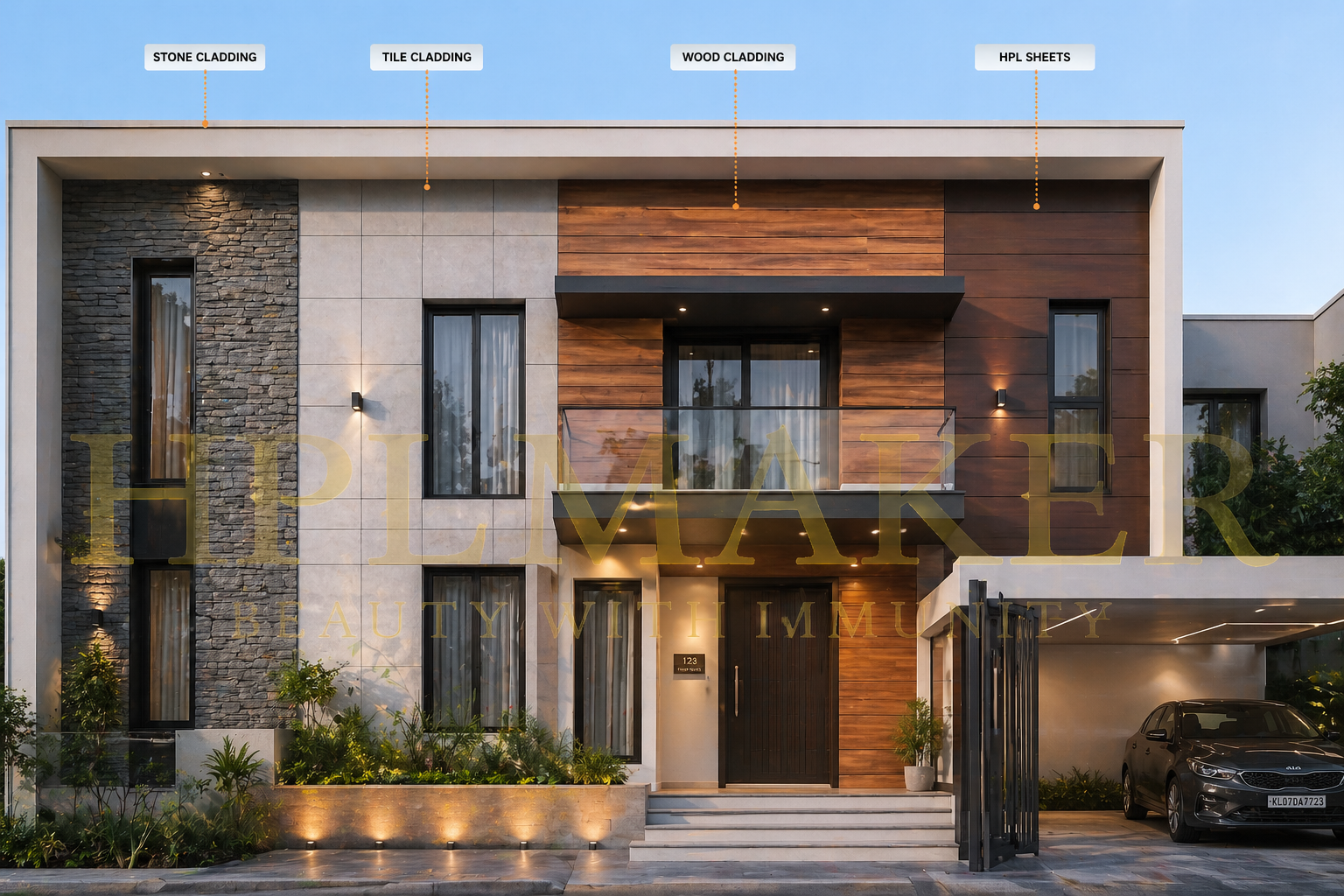
Most facade failures trace back to specification, not installation. A BOQ line reading “HPL cladding as approved” invites substitution with whatever the contractor can source cheapest, and by the time anyone notices, the material is on the wall. Here is what a defensible specification contains.
The Substitution Problem
Interior-grade laminate can cost substantially less than exterior grade and looks identical when new. If your specification does not explicitly exclude it, a value-engineering exercise will find it. The failure appears two summers later, and by then the responsibility conversation is difficult.
Specificity is the only defence.
Clauses to Include
1. Grade — stated explicitly
“Exterior-grade high pressure laminate to EN 438-6 (EDF/EGF as applicable). Interior-grade laminate is not acceptable for external applications.”
2. Thickness — with tolerance
State the nominal thickness and the acceptable tolerance. Under-thickness supply is a real and easily verified problem; a vernier caliper settles it on delivery.
3. UV protection
Specify that the panel shall have a UV-cured surface protection layer, and require the manufacturer to state the process. “UV resistant” as an adjective is not a specification.
4. Fire classification — in full notation
“Classification B-s1,d0 to EN 13501-1, supported by a valid test certificate covering the specified thickness and finish.” Require the certificate at tender stage, not after award.
5. Batch consistency
“All panels for a continuous elevation shall be supplied from a single production batch. Batch numbers to be recorded and submitted.” This one clause prevents the most visible and least fixable defect.
6. Substructure material and spacing
Specify framework material appropriate to exposure, and require spacing calculated against panel thickness, size and design wind load rather than assumed.
7. Cavity and drainage
Specify the ventilated cavity depth, require it to be open at base and head, and state that it shall remain unobstructed by insulation or framework members.
8. Expansion allowance
Require the installation to follow the manufacturer’s stated expansion gap dimensions, with oversized fixing holes as specified.
9. Edge sealing
“All cut edges, particularly horizontal lower edges and fixing penetrations, shall be sealed in accordance with manufacturer’s instructions.”
10. Fixings
Specify corrosion-resistant fixings appropriate to the framework material, and prohibit mixing of dissimilar metals at contact points.
11. Samples and mock-up
Require physical samples for approval, and on projects of scale, a site mock-up panel of adequate size before bulk installation.
12. Warranty documentation
Require the written warranty at handover, with terms, exclusions and claim procedure — not a headline period.
Documents to Collect at Tender
- Manufacturer’s technical data sheet for the exact product
- Fire test certificate covering the specified variant
- EN 438 conformity documentation
- Physical samples of each specified finish
- Installation manual and system details
- Written warranty terms
- Reference projects using the same product
On Site
Verify thickness on delivery with a caliper. Check batch numbers against the submittal. Inspect a sample of panels for edge and surface condition before acceptance. Photograph the framework before panels conceal it — this record is invaluable if a dispute arises later.
Frequently Asked Questions
What is EN 438?
The European standard series for high pressure decorative laminates, including exterior-grade compact laminate performance requirements. It is widely referenced in international specification.
How do I prevent substitution with interior-grade material?
State exterior grade explicitly, require documentation at tender, and verify thickness and batch records on delivery.
Should I specify a brand or a performance standard?
Performance specification with named acceptable equivalents is generally more robust and more procurement-compliant than a single named brand.
Is a site mock-up worth the cost?
On any facade of scale, yes. It resolves shade, texture and detailing questions before bulk installation, when correction is still cheap.
Need specification support? Contact HPLMaker for technical data sheets, certificates and sample submittals.