
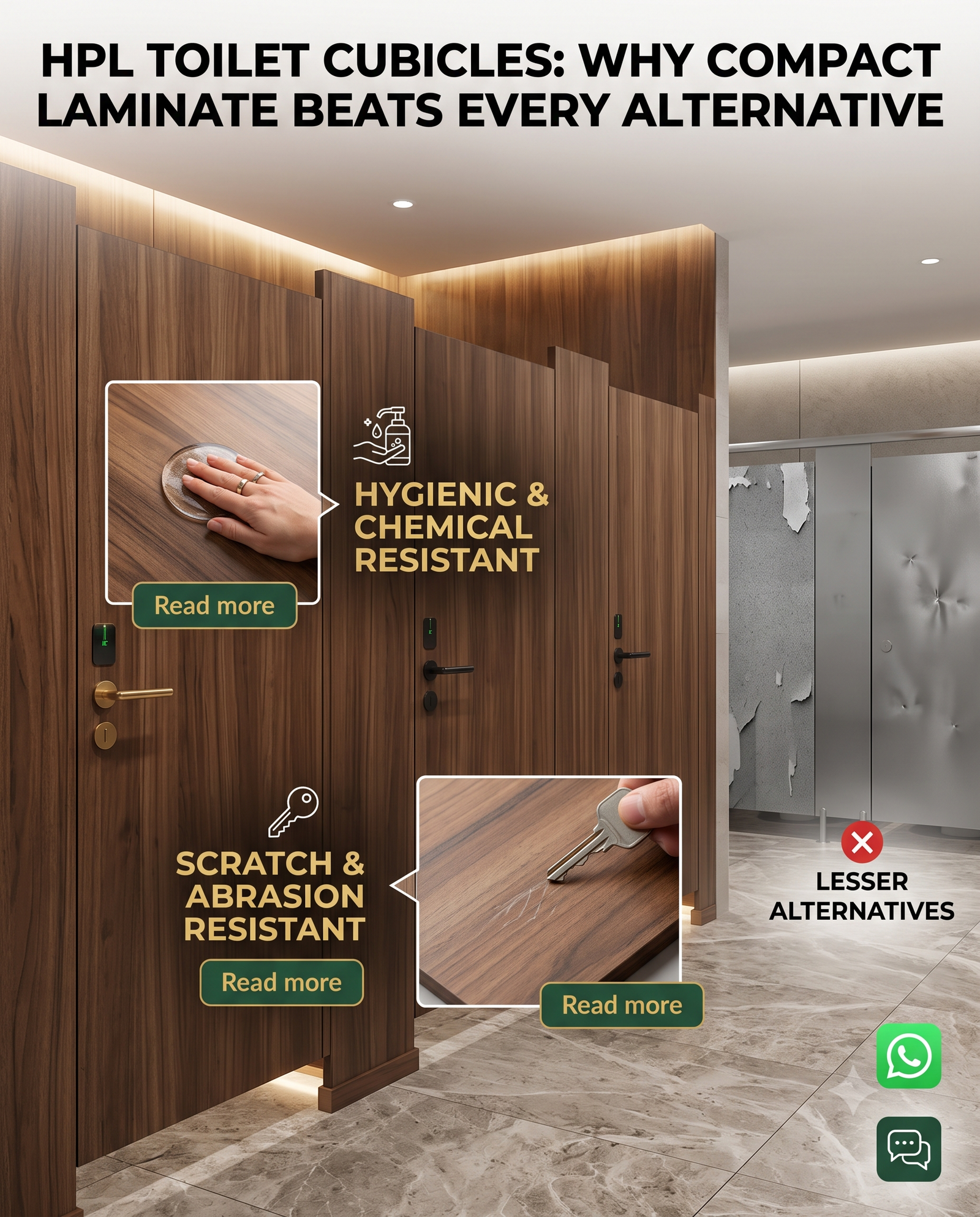
Quick answer: HPL toilet cubicles use 12mm compact laminate panels that are self-supporting, fully water resistant through the thickness, and finished on both faces. Unlike board or metal partitions, they do not swell, rust or delaminate in a wet environment, and they take heavy daily handling and strong cleaning agents without degrading.
Table of Contents
- What Makes a Washroom So Hard on Materials
- Compact Laminate vs the Alternatives
- Specification Checklist for HPL Cubicles
- Hygiene and Cleaning
- Where Cubicle Projects Go Wrong
- Frequently Asked Questions
What Makes a Washroom So Hard on Materials
A public toilet cubicle is exposed to standing water, splashing, steam, aggressive cleaning chemicals, constant door slamming, leaning, and occasional deliberate abuse. It is arguably the most demanding environment inside any building, and it is the one where cheap material choices fail fastest and most visibly.
Compact laminate exists precisely for this condition. It is HPL pressed thick enough – typically 12mm – to stand on its own without a core board, so there is nothing inside to swell.
Compact Laminate vs the Alternatives
| Material | Behaviour in a washroom | Typical life |
|---|---|---|
| 12mm HPL compact laminate | Water resistant through the thickness, no core to swell, easy to clean | 15-20 years |
| Laminated particle board | Swells at the base within months, edges blow out | 2-4 years |
| Powder coated MS | Rusts at cut edges and floor fixings | 5-8 years |
| Glass partitions | Hygienic but heavy, fragile at edges, privacy issues | 10+ years |
| PVC and WPC panels | Light, but flexes and can sag over tall spans | 5-8 years |
| Marble and stone | Durable but heavy, expensive, stains and needs sealing | 20+ years |
Specification Checklist for HPL Cubicles
- Panel thickness: 12mm compact laminate for doors, dividers and pilasters. 10mm may be used for some dividers but 12mm is the reliable standard.
- Hardware: stainless steel grade 304 minimum for hinges, indicator bolts, coat hooks and brackets – this is where cheap cubicle systems fail first.
- Hinges: gravity or self-closing hinges with adjustable closing position, rated for the door weight.
- Floor clearance: raise panels above floor level so wet mopping does not sit against the panel base.
- Pedestal and headrail: anodised or stainless, correctly aligned – misalignment is the most common installation complaint.
- Edge finish: compact laminate is finished on the edge by machining, so no edge banding is required.
Hygiene and Cleaning
Compact laminate has a non-porous surface that does not harbour moisture, which matters in hospitals, schools and food service environments where washroom hygiene is inspected.
- Wipes clean with standard neutral cleaners; no sealing or reproofing is required.
- Tolerates routine disinfectant use far better than coated board or painted metal.
- Avoid abrasive scouring, which dulls the surface and creates micro-texture that traps dirt.
- Graffiti can often be removed from a compact laminate surface without permanent marking, unlike painted partitions.
Where Cubicle Projects Go Wrong
- Using laminated board and calling it HPL – if the panel has a visible core of a different material, it is not compact laminate.
- Buying cheap non-stainless hardware, which rusts within a year in a humid washroom and stains the panel.
- Setting panels directly on the floor with no clearance, so mopping water sits against the base.
- Getting the pedestal height wrong so doors bind or swing open on their own.
- Choosing very light shades in high-traffic public washrooms, which show every handprint.
Key Takeaways
- 12mm compact laminate is the standard for toilet cubicle doors and dividers.
- The panel is self-supporting with no core board to swell in wet conditions.
- Stainless steel 304 hardware is essential; cheap fittings fail first and stain the panels.
- Raise panels off the floor so mopping water does not sit at the base.
- A panel with a visible core of a different material is not compact laminate.
Frequently Asked Questions
What thickness is used for HPL toilet cubicles?
12mm compact laminate is the standard for doors, dividers and pilasters. It is self-supporting, so no backing frame or core board is required, and it is finished on both faces and on the machined edges.
Is HPL waterproof for bathrooms?
Compact laminate has very low water absorption through its full thickness and performs reliably in wet washroom conditions. It does not swell or delaminate the way laminated board partitions do.
How long do HPL cubicles last?
With quality stainless hardware and routine cleaning, 15-20 years is a reasonable expectation in a public washroom, compared with two to four years for laminated particle board partitions.
What hardware should be used with compact laminate cubicles?
Grade 304 stainless steel or better for hinges, indicator bolts, brackets, headrails and coat hooks. Hardware quality is the most common failure point in cubicle systems, not the panel.
Can HPL cubicles be used in schools and hospitals?
Yes, and they are widely specified there because the surface is non-porous, tolerates disinfectants, resists impact and handles heavy daily use. For these building types, also check whether a fire retardant grade is required.
Related Reading on HPL Maker
Talk to HPL Maker
HPL Maker is an Indian manufacturer of exterior-grade high pressure laminate with an industry-first live camera warranty of up to 25 years. Share your drawings or elevation photos and our team will suggest the right shade, thickness and fixing system for your project.
- Call / WhatsApp: +91 89824 90236
- Email: marketing@hplmaker.com
- Factory & Head Office: 124-126, Vrindavan Palace, Nipania Main Road, Vijay Nagar, Indore – 452010, Madhya Pradesh, India