
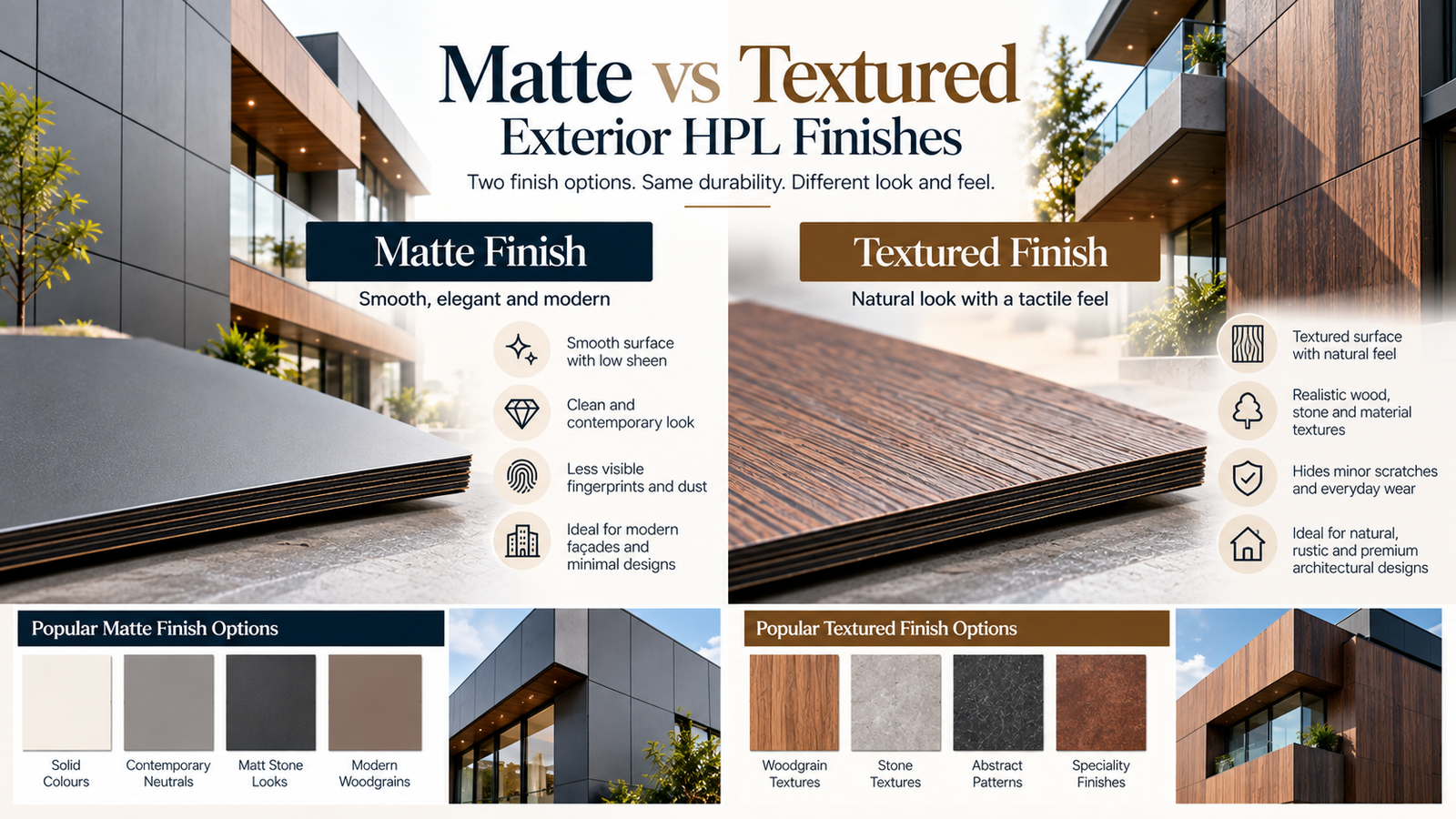
“Matte or textured” sounds like a simple aesthetic choice, and mostly it is — but the two finishes are actually produced differently, and that difference affects more than just how light reflects off the panel.
How a matte finish is produced
A matte exterior HPL surface comes from a smoother press plate during manufacturing, which yields a flatter, low-sheen decorative layer. Light diffuses evenly across it rather than catching on surface variation, which is why matte solid tones photograph as clean and uniform from most viewing angles.
How a textured finish is produced
Textured finishes — wood-grain, stone-effect, and similar — use an embossed press plate that presses a physical texture into the panel surface during the same heat-and-pressure cycle that bonds the decorative layer. This isn’t a printed texture sitting on top; it’s physically embossed into the panel, which is why it reads convincingly at close range and doesn’t wear flat over time the way a surface-applied texture eventually would.
Which one shows dust and watermarking less
Textured surfaces have a practical advantage here — the surface variation visually breaks up dust and light watermarking between washes, in a way a flat matte or gloss surface doesn’t. This isn’t a durability difference, purely a visibility one, but it’s worth knowing if the installation is somewhere dusty or near a busy road.
Which one suits which kind of building
Matte solid tones tend to suit contemporary, geometric architecture where the goal is clean lines doing the visual work. Textured finishes suit builds where the material itself is meant to read as part of the design statement — a stone-effect base, a wood-grain feature panel. Neither is the “better” choice generally; it depends what the elevation is trying to say.
A manufacturing note worth knowing
Because texture is embossed rather than printed, panel-to-panel consistency in a textured run depends on press plate condition and batch consistency — something worth asking about directly if you’re specifying a large single facade where dozens of panels need to read as one continuous surface. This is a reasonable, standard question to ask any HPL supplier, not a red flag specific to any one product.
FAQ
Does texture affect how the panel is fixed and installed?
No, fixing systems are the same regardless of surface finish — texture is purely a surface property.
Can a matte finish be requested in a custom colour not in the standard catalogue?
Yes, subject to a minimum production run — see our post on custom colour matching for how that process works.
Does textured HPL cost more to produce than matte?
Marginally, given the embossing step, though the difference at the retail or project level is usually small relative to overall project cost.