
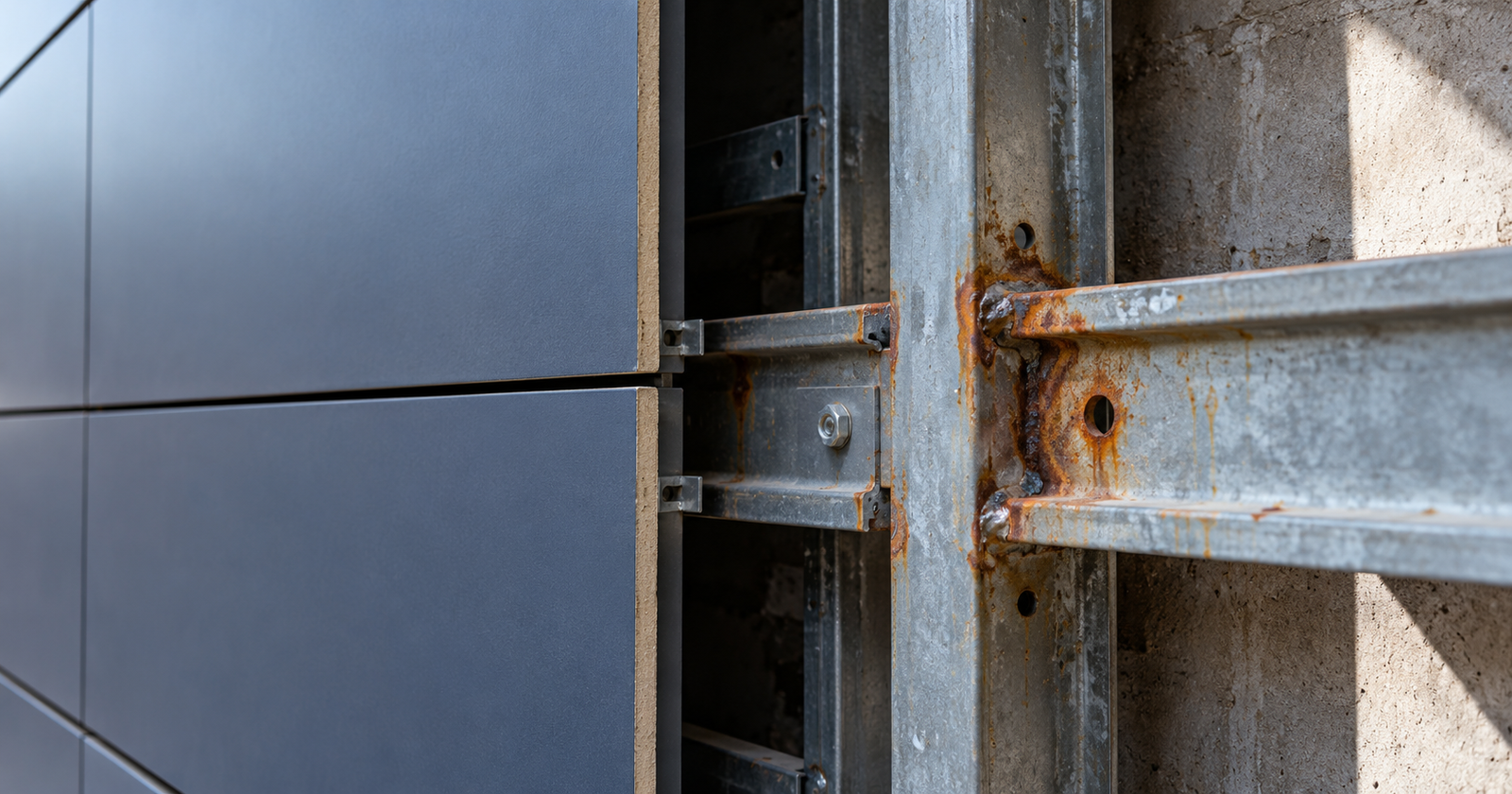
In Indian board-cladding projects, the single most common cause of premature facade failure is plain mild steel angle, welded on site and given a coat of red-oxide primer, then sealed inside a humid cavity where it will never be inspected again. The panels are usually fine. The thing holding them up is not.
Why This Happens So Often
The substructure is invisible. Once the panels go on, nobody sees the frame again for the life of the building. That invisibility makes it the easiest line to cut when a budget is under pressure, and the hardest to audit after the fact.
This is a point we raise with specifiers at HPL Maker more often than any panel question, because it is the one that decides whether a facade reaches year fifteen.
It is also a trade boundary. The panel supplier sells panels. The fabricator welds frames. The architect may specify “MS framework” without a grade, coating system or corrosion class. Nobody owns the gap.
What Actually Goes Wrong
Site welding destroys galvanising
Even where galvanised sections are specified, welding on site burns off the zinc coating at every joint. Unless those joints are treated afterwards with a zinc-rich repair coating, every weld becomes a corrosion initiation point.
Red-oxide primer is not a coating system
A single coat of red-oxide primer is a holding primer. It is intended to protect steel briefly before a proper paint system is applied. Used as the final protection inside a permanently humid cavity, it has a short life.
The cavity is a humid environment by design
A ventilated rainscreen cavity exists precisely so that moisture can enter, drain and evaporate. That is correct building science — but it means the frame lives permanently in damp, ventilated air. Specifying a frame for that environment is different from specifying one for a dry interior.
Cut ends and drilled holes go untreated
Every cut section end and every drilled fixing hole exposes bare steel. These are the first places corrosion starts, and they are routinely left untreated because they are quick and invisible.
Dissimilar metals in contact
Mixing aluminium brackets with steel sections, or using the wrong fastener metal, creates galvanic corrosion at contact points. This accelerates failure well beyond what either metal would experience alone.
What Failure Looks Like
Corrosion does not announce itself. The sequence is usually:
- Rust forms at welds, cut ends and fixing holes, invisible behind the panels
- Section cross-area reduces, and fixing points lose grip
- Panels begin to move slightly in wind, opening joints
- Rust staining appears on the panel face or at the base of the facade
- Individual panels loosen; on upper floors this becomes a safety matter
- Remediation requires stripping the facade — the panels usually survive, the frame does not
By the time anything is visible from outside, the frame has been corroding for years.
Specifying It Properly
- Match the material to the exposure. Aluminium for coastal, high-humidity, high-rise and long-life assets. Hot-dip galvanised as a sound general default. Bare or minimally primed mild steel is a short-term decision in any ventilated cavity.
- Prefer bolted assembly over site welding. Pre-fabricated, pre-coated sections assembled mechanically avoid destroying the coating at every joint.
- Specify treatment of cut ends and drilled holes. Write it into the specification, and check it on site before panels go up.
- Specify the fastener metal and prohibit mixing dissimilar metals at contact points.
- Keep the cavity drained and ventilated. A blocked cavity holds water against the frame continuously rather than letting it dry.
- Photograph the frame before panels are fixed. This is a five-minute task that becomes invaluable evidence if anything is disputed later.
The Budget Argument
Upgrading from site-welded mild steel to a properly coated or aluminium system adds cost per square foot. It is a meaningful number on a large facade.
The comparison, though, is not against the saving. It is against stripping and rebuilding a facade in year eight, including scaffolding, disposal, new frame, re-fixing, and the building looking bad for the years leading up to it.
If a project genuinely cannot afford the right frame, the correct response is to reduce the clad area, not to build the full area on a frame that will not last.
Frequently Asked Questions
What causes most facade cladding failures in India?
Substructure corrosion — typically site-welded mild steel with minimal coating, installed inside a humid ventilated cavity.
Is galvanised steel enough for a cladding frame?
Hot-dip galvanised is a sound default for general work, provided site welds, cut ends and drilled holes are treated. For coastal and high-rise projects, aluminium is the safer specification.
Can a corroded substructure be repaired without removing panels?
Rarely. Meaningful remediation generally requires stripping the facade, which is why specification matters more here than almost anywhere else in the system.
How long should a cladding substructure last?
It should outlast the panels. If the frame fails before the cladding, it was specified for the wrong environment.
Specifying a facade system? Contact HPL Maker for substructure guidance and system documentation.