
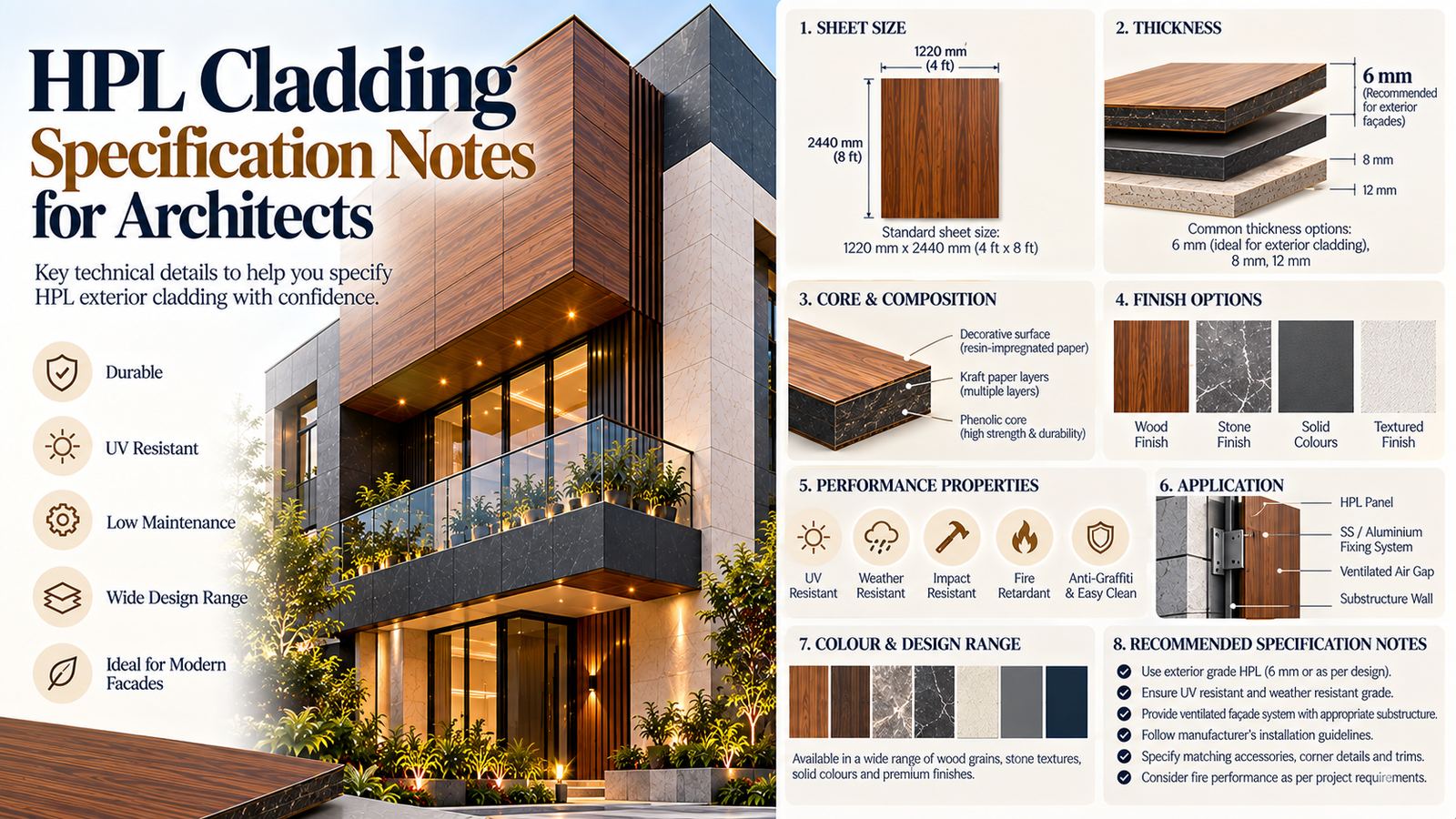
A technical data sheet is where the real specification lives, past the marketing description. Most buyers skim it or skip it entirely — worth spending five minutes on before a large order, since it tells you more than any sales conversation will.
Panel construction and grade
This should state clearly whether the product is compact grade (solid through the thickness) versus a substrate-bonded laminate — see our compact vs standard HPL post for why this distinction matters specifically for exterior use.
Thickness and tolerance
Listed thickness options and the manufacturing tolerance around them (how much a panel might vary from the stated thickness in practice). A wider tolerance range can complicate installation consistency across a large facade, so it’s worth knowing, not just the nominal thickness figure.
Fire performance classification
Should reference a specific, named test standard and the classification achieved for that exact panel grade and thickness — a vague “fire safe” statement without a named standard isn’t a data sheet doing its job.
Weathering and colour-fastness rating
Often expressed as a rating tied to accelerated weathering test hours or cycles, indicating how much UV/moisture exposure the panel was tested against before showing measurable colour change.
Dimensional stability figures
Thermal expansion coefficient — how much the panel physically expands and contracts with temperature swings — which directly informs how joint gaps should be specified during installation (see our specification content on this topic elsewhere on the site).
What a good data sheet looks like versus a weak one
A genuinely useful data sheet names specific test standards, gives numeric tolerances rather than vague statements, and is dated and traceable to a specific product line and grade. If a supplier’s documentation is generic marketing copy dressed up as a spec sheet, that’s worth noticing.
FAQ
Should every buyer request and read this, even for a single home?
It’s more relevant at project scale, but there’s no harm in requesting it for any order — a supplier confident in their product will provide it readily.
What if two suppliers’ data sheets use different test standards and I can’t compare directly?
This is common across the industry — ask both suppliers to confirm which international or national standard their figures reference, so you’re comparing like for like.
Does HPLMaker provide data sheets before an order is placed, or only after?
Available on request before ordering — this is exactly the kind of document a serious buyer should see upfront.