
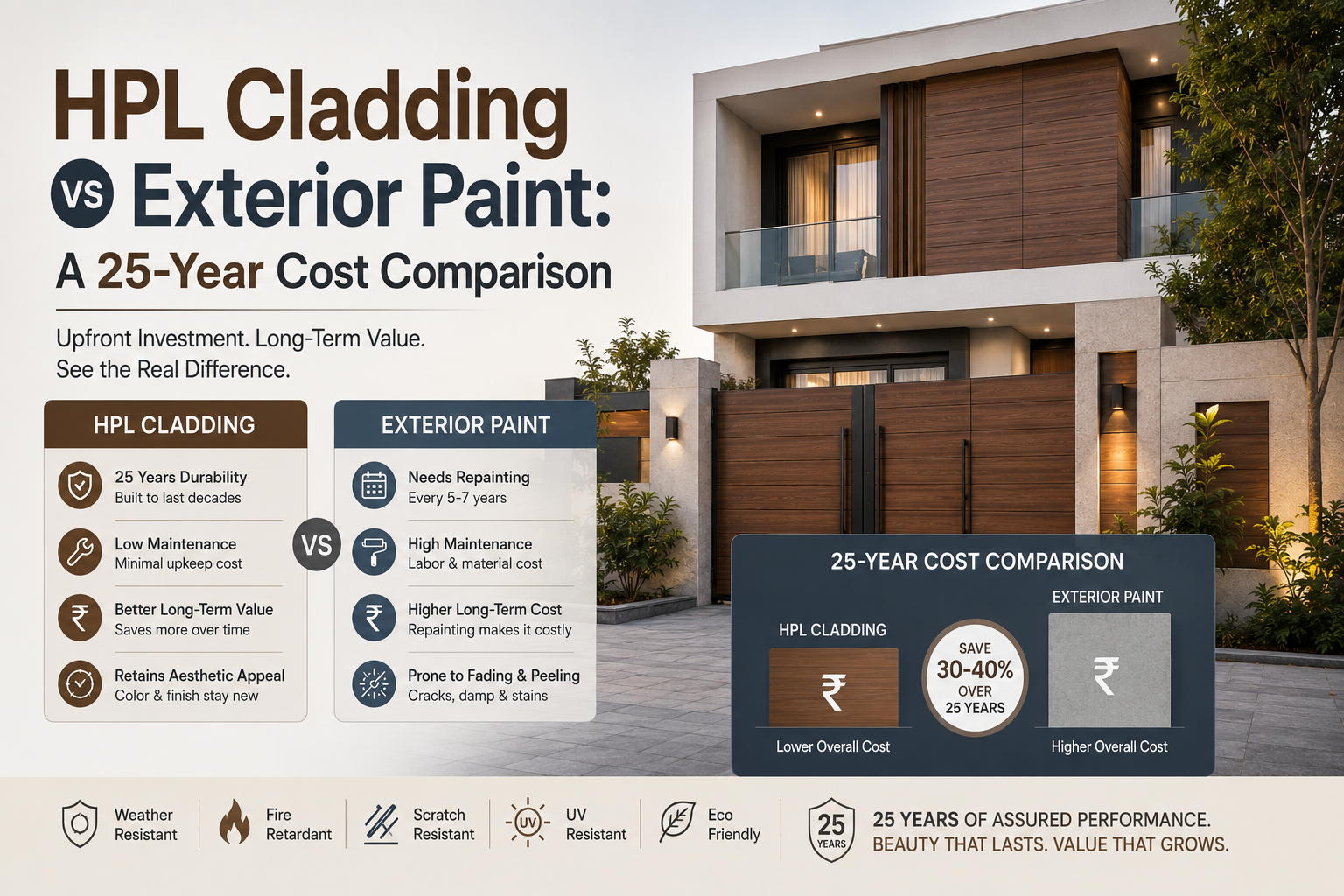
Quick answer: Exterior paint costs far less upfront but typically needs redoing every four to six years in Indian conditions, each time with scaffolding, labour and disruption. HPL cladding costs more once and then needs only washing. Over a 25-year horizon the two usually converge, and HPL often finishes ahead once scaffolding and repair work are counted honestly.
Table of Contents
- The Comparison Nobody Runs Properly
- What Exterior Paint Really Costs Over Time
- An Illustrative 25-Year Comparison
- The Benefits That Never Show Up in a Paint Quote
- When Paint Is Still the Right Answer
- Frequently Asked Questions
The Comparison Nobody Runs Properly
Almost every facade decision in India is made by comparing one number to another number: the cost of painting a wall against the cost of cladding it. Paint wins comfortably, the decision is made, and the real cost arrives in instalments over the next twenty years.
The fair comparison is total cost of ownership – what the wall costs you across its life, including everything you have to do to it to keep it looking acceptable.
What Exterior Paint Really Costs Over Time
A good exterior emulsion on a properly prepared wall lasts a genuine four to six years in most Indian cities before fading, chalking or peeling become visible. On a west-facing wall or in a coastal city, it can be less. Each repaint cycle includes:
- Surface preparation – scraping, crack filling, priming, sometimes plaster repair.
- Scaffolding or rope access, which on a multi-storey building can rival the paint cost itself.
- Labour and materials for two coats.
- Disruption – covered windows, restricted balconies, noise and dust for one to three weeks.
- Society or management coordination costs on shared buildings.
Four repaint cycles across 25 years is a conservative assumption. Many buildings do five.
An Illustrative 25-Year Comparison
The figures below are illustrative planning numbers for a mid-size Indian building elevation, not a quotation. Use them as a structure for your own calculation with local rates.
| Cost head | Exterior paint route | HPL cladding route |
|---|---|---|
| Initial cost | Low | High – the full facade system |
| Repaint or reclad cycles in 25 years | 4 to 5 | 0 |
| Scaffolding events | 4 to 5 | 1 |
| Routine maintenance | Washing plus crack repair | Washing only |
| Occupant disruption | Every cycle, 1-3 weeks | Once, at installation |
| Appearance in year 20 | Depends entirely on the last repaint | Substantially as installed |
| Wall protection | Surface film only | Full rainscreen with drainage and shading |
The Benefits That Never Show Up in a Paint Quote
- Thermal performance – a ventilated HPL facade removes solar heat before it reaches the wall, lowering internal surface temperature and cooling load. Paint does nothing for this.
- Damp control – the rainscreen keeps wind-driven rain off the plaster, which is the root cause of most interior damp patches in Indian monsoon.
- Defect coverage – cladding hides cracked plaster and patch repairs permanently; paint highlights them within a season.
- Resale and rental value – a building with a clean modern envelope commands better perception than one with a fresh coat over an old surface.
- Predictability – no recurring capital demand every five years, which matters a great deal for societies and institutions.
When Paint Is Still the Right Answer
Cladding is not always correct, and pretending otherwise helps nobody. Paint remains the sensible choice when:
- The building will be sold, redeveloped or heavily altered within a few years.
- The structure genuinely cannot take additional dead load without assessment.
- The budget for this cycle is fixed and small, and a full facade is simply not fundable.
- The wall is heritage or has surface treatment that should not be covered.
A common middle path is to clad the elevations that face weather and public view, and paint the rest. It captures most of the benefit at a fraction of the cost.
Key Takeaways
- Paint typically needs four to five repaint cycles in 25 years; HPL needs none.
- Scaffolding and disruption are real costs that paint quotations rarely include.
- A ventilated HPL facade also reduces heat gain and protects walls from monsoon damp.
- Cladding covers permanent surface defects that paint keeps exposing.
- Paint remains sensible for short-hold, budget-constrained or heritage situations.
Frequently Asked Questions
Is HPL cladding cheaper than painting in the long run?
Over a 25-year horizon the two often converge, and HPL frequently finishes ahead once repeated scaffolding, surface preparation and disruption are counted. On the first invoice, paint is always cheaper.
How often does an Indian building need repainting?
Typically every four to six years for exterior emulsion, and sometimes sooner on west-facing or coastal elevations where UV and salt exposure are harsher.
Does HPL cladding increase property value?
A clean, modern and low-maintenance envelope generally improves buyer and tenant perception, and the absence of a recurring repaint liability is a genuine selling point for societies and commercial owners.
Can I clad only part of a building?
Yes, and it is a common approach. Many owners clad the front elevation and the weather-facing sides and paint the remaining walls, which captures most of the visual and protective benefit at lower cost.
Does cladding add load to the building?
Yes, HPL and its aluminium sub-frame add dead load to the envelope. It is modest and routine to design for, but the structural consultant should confirm anchor and wall capacity before installation.
Related Reading on HPL Maker
Talk to HPL Maker
HPL Maker is an Indian manufacturer of exterior-grade high pressure laminate with an industry-first live camera warranty of up to 25 years. Share your drawings or elevation photos and our team will suggest the right shade, thickness and fixing system for your project.
- Call / WhatsApp: +91 89824 90236
- Email: marketing@hplmaker.com
- Factory & Head Office: 124-126, Vrindavan Palace, Nipania Main Road, Vijay Nagar, Indore – 452010, Madhya Pradesh, India