
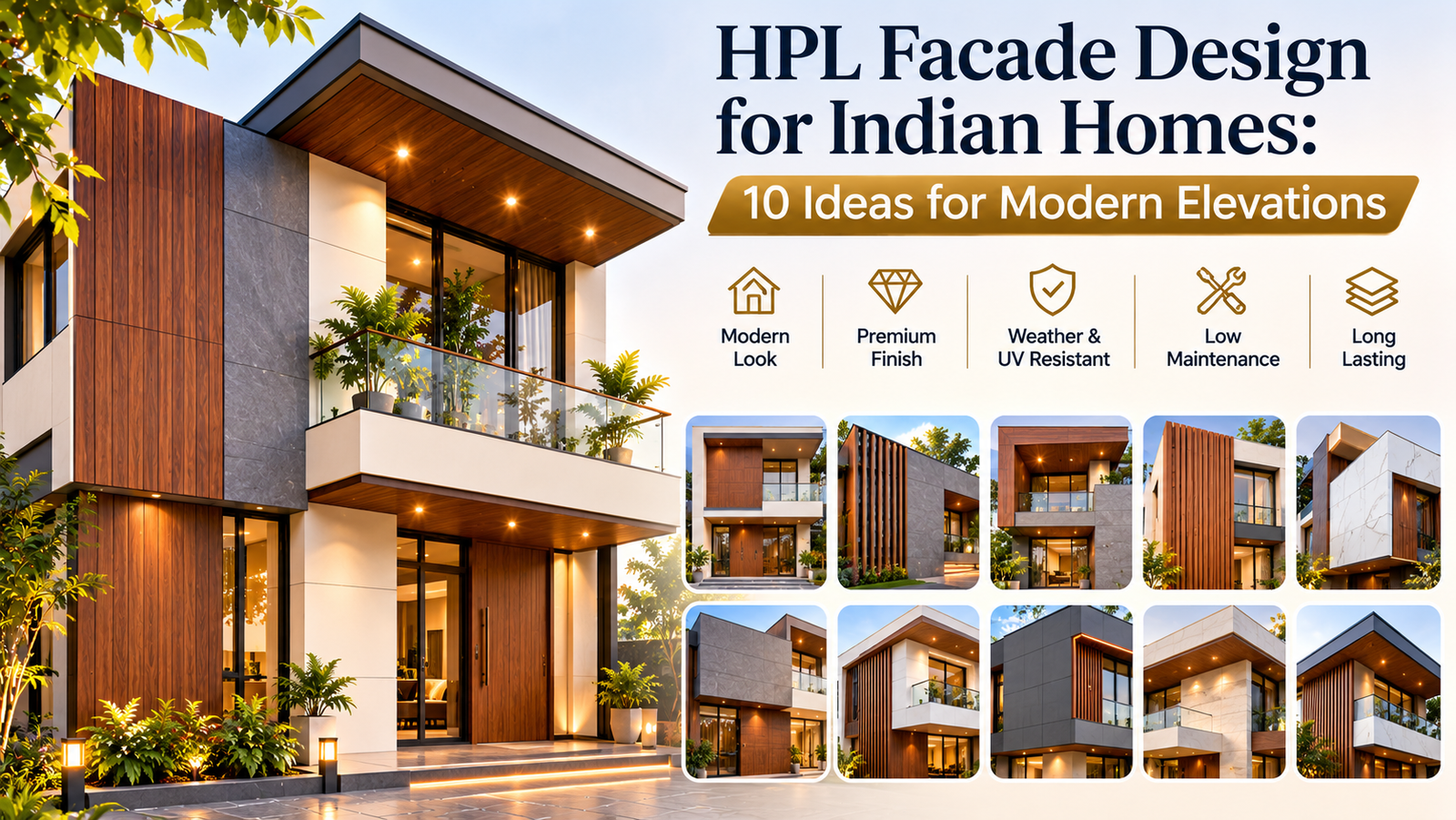
HPL facade design gives Indian homes a way to add architectural depth, texture and a finished exterior without relying only on paint or conventional stone. From warm wood-look elevations to sharp geometric bands, exterior-grade HPL can be used as a focused design material rather than covering an entire building.
Why HPL Works Well for Contemporary Home Elevations
A modern elevation usually needs contrast. A painted wall provides the mass, while HPL can define the entrance, balcony, parapet, vertical fins or a feature volume. Because the decorative surface is factory finished, the visual result is more consistent than a finish created entirely on site.
For Indian projects, the specification still matters: use exterior-grade material, select the appropriate thickness and make sure the supporting framework, ventilation and drainage are designed correctly.
10 HPL Facade Ideas
1. Wood-Look Entrance Frame
Use a wood-grain HPL band around the main entrance to create a warm focal point against a light plastered facade. Keeping the HPL concentrated around the doorway avoids making the elevation visually heavy.
2. Full-Height Balcony Feature
A vertical HPL panel behind a balcony can visually connect multiple floors. Vertical grain or narrow panel modules can make a compact elevation appear taller.
3. Floating Box Design
Create the appearance of a projecting architectural box by cladding one upper-floor volume in HPL. The contrast between the clad volume and the surrounding wall gives the elevation depth.
4. HPL with Stone
Pair a stone or stone-look surface with a restrained wood-look HPL. Use one material as the dominant finish and the other as an accent.
5. Vertical Fins
Vertical HPL fins can create rhythm across a blank wall while also adding visual screening. Their spacing should be coordinated with the facade structure and fixing system.
6. Balcony Privacy Screen
Where the design permits, patterned or carefully spaced HPL elements can create a semi-private balcony layer. Any perforation or routing should be engineered for the panel specification and wind loads.
7. Ground-Floor Plinth Accent
A darker HPL band at the entrance or plinth can visually anchor a large house. Keep the detailing simple so dirt and splash marks are easier to manage.
8. Monochrome Contemporary Elevation
Use a single neutral HPL tone with white, grey or charcoal architectural surfaces. This works especially well when the building has strong geometric lines.
9. Mixed Horizontal and Vertical Modules
Change the orientation of HPL modules to define different facade zones. The grid should be planned before fabrication so joints look intentional rather than accidental.
10. Feature Wall for the Staircase
A tall stairwell volume is a natural place for a vertical HPL feature. A continuous material language from exterior to selected interior areas can also strengthen the architectural concept.
How Much HPL Should You Use?
More HPL does not automatically mean a better elevation. A strong design often uses HPL on 20–40% of the visible facade and allows the remaining surfaces to provide contrast. The right proportion depends on the architecture, panel colour and surrounding materials.
What to Specify Before Ordering
- Exterior-grade HPL suitable for the intended exposure
- Panel thickness and dimensions
- Decor and surface finish
- Fire-performance requirement where applicable
- Substructure material and corrosion protection
- Joint width and fixing method
- Ventilation and drainage behind the cladding
- Batch consistency and spare-panel requirement
Frequently Asked Questions
Is HPL suitable for a house exterior?
Yes, exterior-grade HPL is designed for outdoor applications when the complete facade system is correctly specified and installed.
Can HPL be used with stone and paint?
Yes. Combining HPL with plaster, paint, stone and metal can create a more balanced elevation than using one material everywhere.
Which HPL finish is best for a modern house?
It depends on the architecture. Wood-look finishes create warmth, while solid colours and stone-inspired surfaces can produce a more minimal appearance.
Planning a residential elevation? HPL Maker can help you select exterior-grade HPL, finishes and project quantities for your design.