
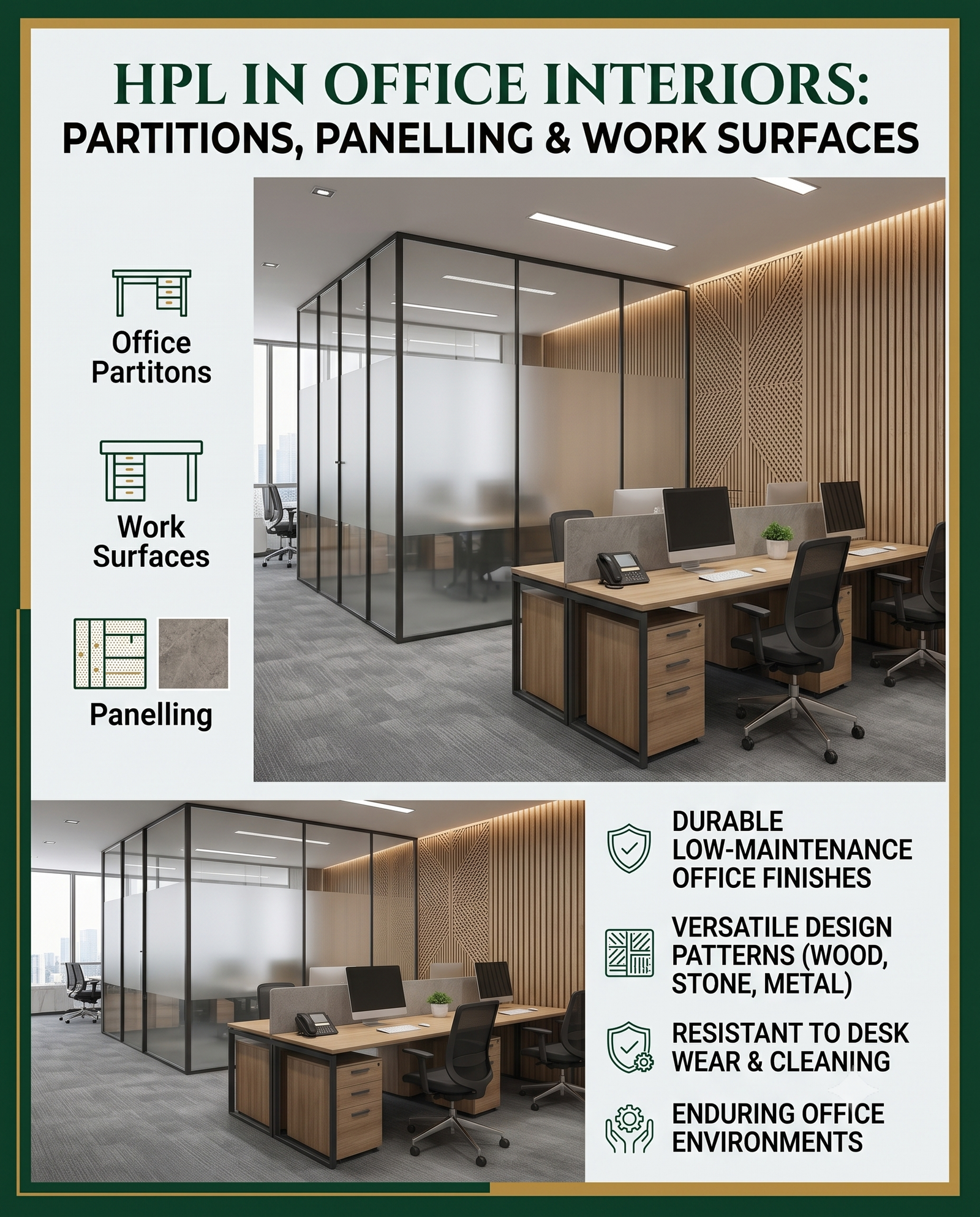
Quick answer: HPL is used in offices for wall panelling, partition infills, lockers, storage shutters, reception desks and work surfaces. It resists scuffing, cleaning chemicals and heavy handling far better than painted surfaces or veneer, and compact grades are self-supporting for partitions and lockers.
Table of Contents
- Where HPL Earns Its Place in an Office
- The Fitout Economics
- Choosing Finishes for a Workplace
- Fire and Acoustic Considerations
- Detailing Tips for Interior Work
- Frequently Asked Questions
Where HPL Earns Its Place in an Office
| Application | Recommended grade | Why HPL |
|---|---|---|
| Wall panelling and feature walls | 0.8-3mm on a board substrate, or 6mm direct | No repainting, hides scuffs, easy to clean |
| Partition infill panels | 6-12mm depending on framing | Stable, acoustic backing possible, wide decor range |
| Lockers and storage | 12mm compact | Self-supporting, no swelling, high abuse tolerance |
| Reception desks and counters | Compact or laminate on substrate | Impact resistant edges, seamless appearance |
| Work surfaces and pantry tops | 12mm compact | Heat and stain resistant, hygienic, no sealing |
| Lift lobby and column cladding | 3-6mm | Withstands trolley and luggage contact |
The Fitout Economics
Commercial interiors in India are typically refreshed every five to eight years, and a substantial part of that spend goes on repairing surfaces that could not take normal use: scuffed painted walls, chipped veneer edges, swollen pantry counters, dented locker doors.
Specifying HPL in the high-contact zones changes that arithmetic. The surfaces that get touched, wheeled into and cleaned daily survive the full lease term, so the refresh becomes a cosmetic change rather than a rebuild.
Choosing Finishes for a Workplace
- Matt and super-matt finishes reduce glare under office lighting and photograph better for brand imagery.
- Anti-fingerprint surfaces are worth the premium on dark shades in reception and meeting areas.
- Warm woods soften open-plan spaces that are otherwise all glass and metal.
- Solid neutrals work best where the brand colour is applied through graphics and furniture rather than through the wall.
- Textured surfaces hide the everyday marks that flat gloss shows immediately.
Fire and Acoustic Considerations
Commercial fitouts have obligations that a home does not. Two in particular affect laminate selection:
- Fire performance. Many office buildings, and virtually all IT parks and multi-tenant towers, require fire retardant grade for wall linings and partitions. Confirm the requirement with the building’s fire consultant before ordering, and get the classification in writing from the supplier.
- Acoustics. HPL itself is a hard, reflective surface. Where speech privacy matters, use it as the visible face of a build-up that includes an absorptive layer behind, or alternate laminate panels with acoustic panels rather than lining a whole meeting room in hard surface.
Detailing Tips for Interior Work
- Plan panel joints to align with door frames and ceiling grid lines – a misaligned joint is obvious indoors at close range.
- Use shadow-gap or aluminium reveal profiles at panel edges rather than trying to butt panels perfectly.
- Specify a matching or deliberately contrasting edge treatment on compact panels; the machined dark core edge can be a design feature.
- For work surfaces, radius all exposed corners for both safety and durability.
- Keep spare panels from the same batch for the inevitable future alteration.
Key Takeaways
- HPL suits high-contact office surfaces: panelling, partitions, lockers, counters and worktops.
- 12mm compact is self-supporting for lockers, partitions and pantry tops.
- Confirm fire retardant grade requirements with the building’s fire consultant before ordering.
- HPL is acoustically reflective – pair it with absorptive layers where speech privacy matters.
- Align panel joints with doors and ceiling grid, and use reveal profiles at edges.
Frequently Asked Questions
Can HPL be used for office partitions?
Yes. Compact HPL of 10-12mm is self-supporting and widely used for partition infills, while thinner laminate can be bonded to a substrate within a framed partition system.
Is HPL good for office desks and counters?
Compact laminate makes an excellent work surface because it resists heat, stains, impact and cleaning chemicals, needs no sealing, and can be machined with a radiused edge for safety.
Do offices need fire retardant HPL?
Many commercial buildings, particularly multi-tenant towers and IT parks, require fire retardant grade for wall linings and partitions. Confirm the specific requirement with the building’s fire consultant and obtain the tested classification from the supplier.
Does HPL make an office noisy?
HPL is a hard reflective surface, so lining an entire meeting room in it can increase reverberation. Combine it with absorptive materials such as acoustic panels, carpet and soft furnishings to balance the room.
How does HPL compare to veneer in an office?
Veneer offers genuine timber character but scratches, needs periodic polishing and marks easily at high-contact points. HPL trades authentic grain for far better resistance to scuffing, cleaning agents and daily handling.
Related Reading on HPL Maker
Talk to HPL Maker
HPL Maker is an Indian manufacturer of exterior-grade high pressure laminate with an industry-first live camera warranty of up to 25 years. Share your drawings or elevation photos and our team will suggest the right shade, thickness and fixing system for your project.
- Call / WhatsApp: +91 89824 90236
- Email: marketing@hplmaker.com
- Factory & Head Office: 124-126, Vrindavan Palace, Nipania Main Road, Vijay Nagar, Indore – 452010, Madhya Pradesh, India