
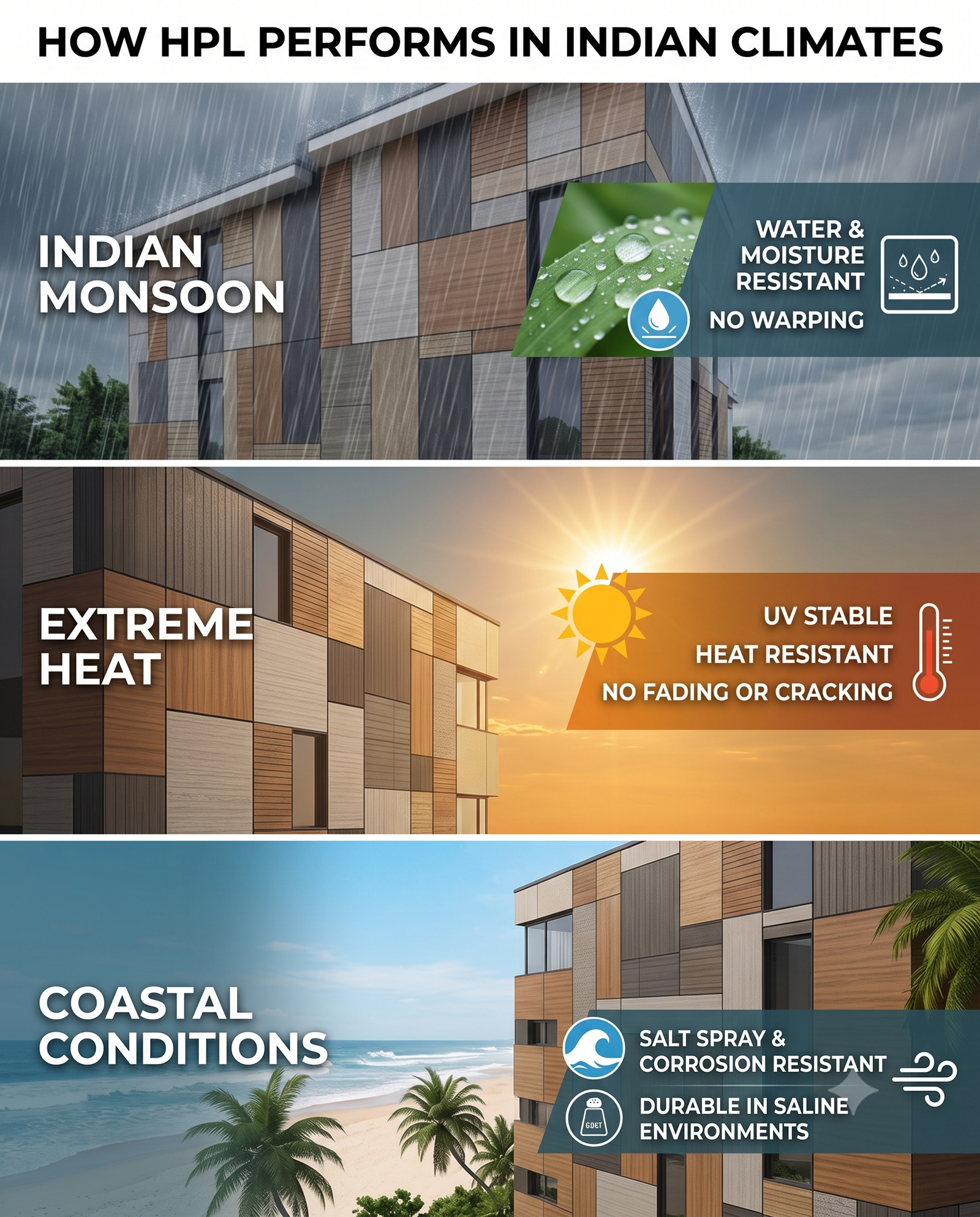
Quick answer: Exterior-grade HPL has very low water absorption, holds colour under intense UV, and does not corrode in salt air, which makes it well suited to Indian conditions. Climate mainly affects detailing rather than the panel: hot zones need movement allowance, monsoon zones need drainage discipline, and coastal zones need corrosion-resistant fixings.
Table of Contents
- Four Climates, One Material
- Monsoon: Water Is Not the Enemy, Trapped Water Is
- Heat: Design for Movement
- Coastal Sites: The Fixings Decide the Outcome
- Dust, Pollution and Appearance Over Time
- Frequently Asked Questions
Four Climates, One Material
A facade specification that works in Indore is not automatically right in Kochi. The panel itself is the same product, but the detailing around it should respond to what the local weather actually does.
| Zone | Dominant stress | What to prioritise |
|---|---|---|
| Hot and dry (Rajasthan, Gujarat, MP) | UV intensity, large daily temperature swing | Movement allowance, joint width, UV-grade surface |
| Hot and humid coastal (Mumbai, Chennai, Kochi, Goa) | Salt air, driving rain, humidity | Corrosion-resistant fixings and sub-frame, drainage |
| Heavy monsoon (Konkan, Northeast, Western Ghats) | Weeks of wind-driven rain | Cavity drainage, coping details, ventilation |
| Composite north (Delhi NCR, UP, Punjab) | Heat, dust, pollution, cold winters | Cleaning access, mid-tone shades, thermal cycling |
Monsoon: Water Is Not the Enemy, Trapped Water Is
Exterior HPL has very low water absorption, so rain landing on the panel face is a non-event. The risks in a monsoon climate sit around the panel, not on it.
- Keep the cavity draining. Water entering an open joint must have a clear path down and out at the base. A blocked or sealed cavity base turns a rainscreen into a water tank.
- Detail copings and heads properly with a fall and a drip edge so water separates from the panel face instead of tracking behind it.
- Ventilate. Air movement in the cavity dries the wall between rain events, which is what keeps interior plaster free of damp patches.
- Protect the sub-frame. The panel is fine in water; untreated steel framing behind it is not.
- Clear the mesh. Insect mesh at cavity openings collects leaves and dust and should be cleaned before every monsoon.
Heat: Design for Movement
A west-facing dark panel in central India can reach a very high surface temperature in the afternoon and drop dramatically overnight. That cycle repeats daily for decades, and it is the reason movement allowance is not optional.
- Use the manufacturer’s stated joint width for the panel size in use, and never reduce it to make the elevation look tighter.
- Oversize fixing holes and keep one fixed point per panel.
- Prefer mid-tone shades over charcoal and black on large west and south elevations.
- Remember that the ventilated cavity is doing real work here – it removes much of the absorbed heat before it reaches the wall.
- Never store panels leaning in direct sun before installation; they will take a permanent bow.
Coastal Sites: The Fixings Decide the Outcome
Salt-laden air is the harshest environment in Indian construction. HPL itself does not corrode, which is a genuine advantage over metal cladding. Everything holding it up, however, is metal.
- Specify stainless steel or high-grade coated fasteners throughout; ordinary fasteners will bleed rust stains down the panel face within a season.
- Use aluminium sub-framing rather than steel wherever possible, and ensure any steel is fully protected.
- Isolate dissimilar metals to prevent galvanic corrosion at bracket-to-frame junctions.
- Increase cleaning frequency to three or four times a year, focusing on rinsing salt deposits off rather than scrubbing.
- Inspect brackets annually at accessible points – corrosion starts where you cannot see it.
Dust, Pollution and Appearance Over Time
In northern and western India, airborne dust is abrasive and constant. It does not damage a hard laminate surface the way it dulls softer coatings, but it does affect appearance between cleaning cycles.
Practical responses: choose mid-tone and textured shades over very light flat colours in high-dust urban locations, keep light shades for upper levels where they stay cleaner, and plan realistic access for cleaning at design stage rather than discovering later that half the elevation is unreachable.
Key Takeaways
- Exterior HPL handles rain, UV and salt air well; detailing around it decides real performance.
- In monsoon zones, keep the cavity draining, ventilated and clear at the base.
- In hot zones, respect movement allowance and prefer mid-tones on sun-facing elevations.
- On coastal sites, fixings and sub-frame corrosion resistance matter more than the panel.
- In dusty cities, favour mid-tone or textured shades and plan cleaning access early.
Frequently Asked Questions
Is HPL waterproof in monsoon?
Exterior-grade HPL has very low water absorption and is unaffected by heavy rain on its face. Facade performance in monsoon depends on the cavity draining freely and on coping and head details shedding water away from the panel.
Does HPL fade in strong Indian sunlight?
Exterior grade with a UV-protective surface is engineered to resist fading for many years. Interior-grade laminate used outdoors will fade visibly within one to three summers, which is why grade verification matters.
Is HPL suitable for coastal cities like Mumbai or Chennai?
Yes, and it has a real advantage over metal cladding because the laminate itself does not corrode. The critical requirement is corrosion-resistant fixings and sub-framing, plus more frequent rinsing to remove salt deposits.
Does HPL expand in heat?
It expands and contracts slightly with temperature and humidity, which is why fixing holes are oversized, one fixed point is used per panel, and joints are sized to the manufacturer’s specification. Rigid fixing is the most common cause of bowing.
How often should a coastal HPL facade be cleaned?
Three to four times a year is a reasonable target in salt-laden air, with the emphasis on rinsing deposits away rather than scrubbing. Annual inspection of brackets and fixings is also worthwhile.
Related Reading on HPL Maker
Talk to HPL Maker
HPL Maker is an Indian manufacturer of exterior-grade high pressure laminate with an industry-first live camera warranty of up to 25 years. Share your drawings or elevation photos and our team will suggest the right shade, thickness and fixing system for your project.
- Call / WhatsApp: +91 89824 90236
- Email: marketing@hplmaker.com
- Factory & Head Office: 124-126, Vrindavan Palace, Nipania Main Road, Vijay Nagar, Indore – 452010, Madhya Pradesh, India