
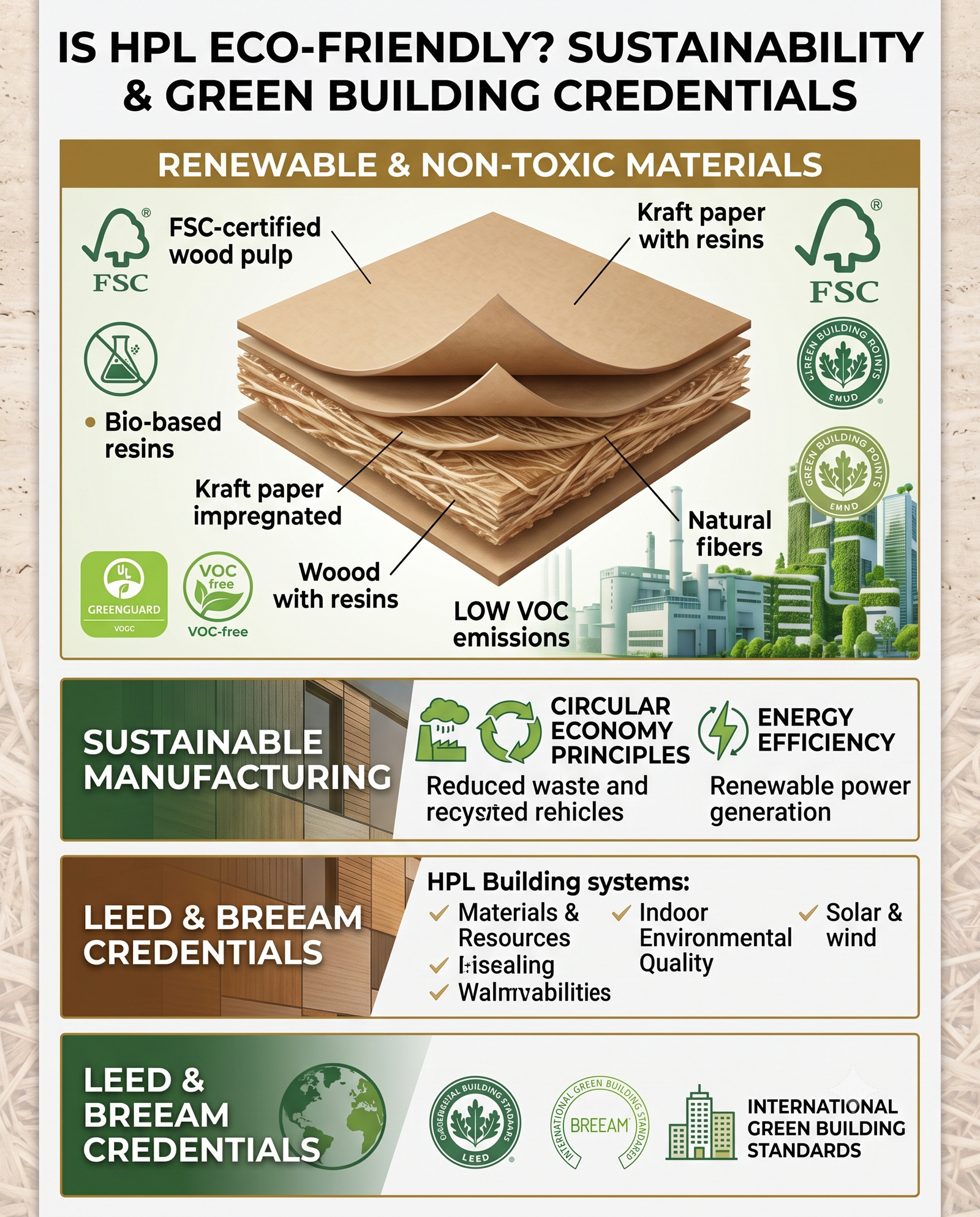
Quick answer: HPL is made largely from paper and thermosetting resin, is manufactured with significant heat and pressure, and lasts two decades or more with only washing. Its main environmental case is service life and the operational energy saved by a ventilated facade, rather than a low-impact manufacturing process.
Table of Contents
- Start With Honesty About What HPL Is
- Where the Environmental Case Is Genuinely Strong
- Where It Is Weaker
- Green Rating Systems in India
- The Practical Conclusion
- Frequently Asked Questions
Start With Honesty About What HPL Is
Any material marketed as green deserves scepticism, and HPL is no exception. It is made of kraft paper, which comes from wood pulp, saturated with thermosetting resins, then cured under heat and pressure. That process consumes real energy, and the cured thermoset cannot be melted down and reformed the way a thermoplastic can.
So the honest position is this: HPL is not a low-impact material at the point of manufacture. Its environmental case rests on what happens over the following twenty-five years.
Where the Environmental Case Is Genuinely Strong
- Service life. A material that lasts 20-25 years without recoating avoids four to five repaint cycles, each with its own paint manufacture, solvent release, scaffolding and transport footprint. Longevity is the most underrated environmental property in construction.
- Operational energy. A ventilated rainscreen removes solar heat from behind the panel by convection before it reaches the wall, reducing cooling load. In an Indian climate, cooling energy dominates a building’s operational footprint.
- No maintenance chemicals. Washing with mild detergent is the entire maintenance regime – no solvents, no primers, no annual coatings.
- Renovation instead of demolition. Cladding an existing tired building extends its life and avoids the very large embodied carbon of demolition and rebuild.
- Material efficiency. A thin, strong panel covers a large area with modest mass compared with stone or masonry alternatives.
Where It Is Weaker
- Manufacturing energy is significant because of the heat and pressure required.
- Not mechanically recyclable into new laminate, because thermosetting resin cannot be remelted.
- Combustible in standard grades, which is a safety consideration rather than an environmental one but belongs in an honest assessment.
- Sub-frame footprint – aluminium framing carries its own embodied energy and should be counted in any comparison.
Offcuts and end-of-life panels are generally handled through downcycling and energy recovery routes rather than closed-loop recycling. Ask your supplier what routes exist locally rather than accepting a general claim.
Green Rating Systems in India
Indian projects pursuing IGBC, GRIHA or LEED certification do not earn points for a material simply being HPL. Points come from documented attributes, so ask for what the rating system actually needs:
| Credit area | What to ask the supplier for |
|---|---|
| Indoor environmental quality | Low VOC emission test data for interior applications |
| Sustainable materials | Recycled content, responsibly sourced paper documentation |
| Regional materials | Manufacturing location and distance to site |
| Energy performance | Thermal modelling support for the ventilated facade contribution |
| Product transparency | Environmental Product Declaration if available |
A supplier who can produce this documentation is genuinely useful to a green-rated project. One who simply says ‘eco-friendly’ is not.
The Practical Conclusion
If you are choosing between HPL and a material that needs recoating every five years, HPL almost certainly wins over a building life. If you are choosing between cladding an existing building and demolishing it, cladding wins decisively. If you are comparing HPL against doing nothing to a wall that is performing well, the environmental case is weak.
The most sustainable facade is the one that gets specified correctly, installed properly, and never has to be touched again for twenty-five years.
Key Takeaways
- HPL’s environmental case rests on long service life, not on low-impact manufacturing.
- Avoiding four to five repaint cycles is a substantial lifetime saving.
- A ventilated facade reduces cooling load, which dominates Indian operational energy.
- Thermoset resin means HPL is not closed-loop recyclable into new laminate.
- For green ratings, ask for documented test data rather than accepting general claims.
Frequently Asked Questions
Is HPL environmentally friendly?
Its strongest environmental argument is service life – twenty years or more without recoating avoids repeated repaint cycles and their associated materials and transport. Manufacturing is energy intensive, and cured thermoset resin is not recyclable into new laminate.
Can HPL be recycled?
Not into new laminate, because thermosetting resins cannot be remelted. Offcuts and end-of-life panels are typically handled through downcycling or energy recovery, and available routes vary by region.
Does HPL cladding save energy?
Indirectly and meaningfully. A ventilated rainscreen carries solar heat away by convection before it reaches the structural wall, which lowers cooling load – the dominant operational energy use in most Indian buildings.
Does HPL help with IGBC or GRIHA certification?
Only through documented attributes such as low VOC emissions, recycled content, regional manufacturing distance and thermal performance contribution. Ask the supplier for the specific test data the rating system requires.
Is HPL better for the environment than repainting?
Over a twenty-five year horizon, avoiding four to five repaint cycles – with their paint manufacture, transport, scaffolding and solvent release – generally outweighs the one-time impact of cladding an existing wall.
Related Reading on HPL Maker
Talk to HPL Maker
HPL Maker is an Indian manufacturer of exterior-grade high pressure laminate with an industry-first live camera warranty of up to 25 years. Share your drawings or elevation photos and our team will suggest the right shade, thickness and fixing system for your project.
- Call / WhatsApp: +91 89824 90236
- Email: marketing@hplmaker.com
- Factory & Head Office: 124-126, Vrindavan Palace, Nipania Main Road, Vijay Nagar, Indore – 452010, Madhya Pradesh, India