
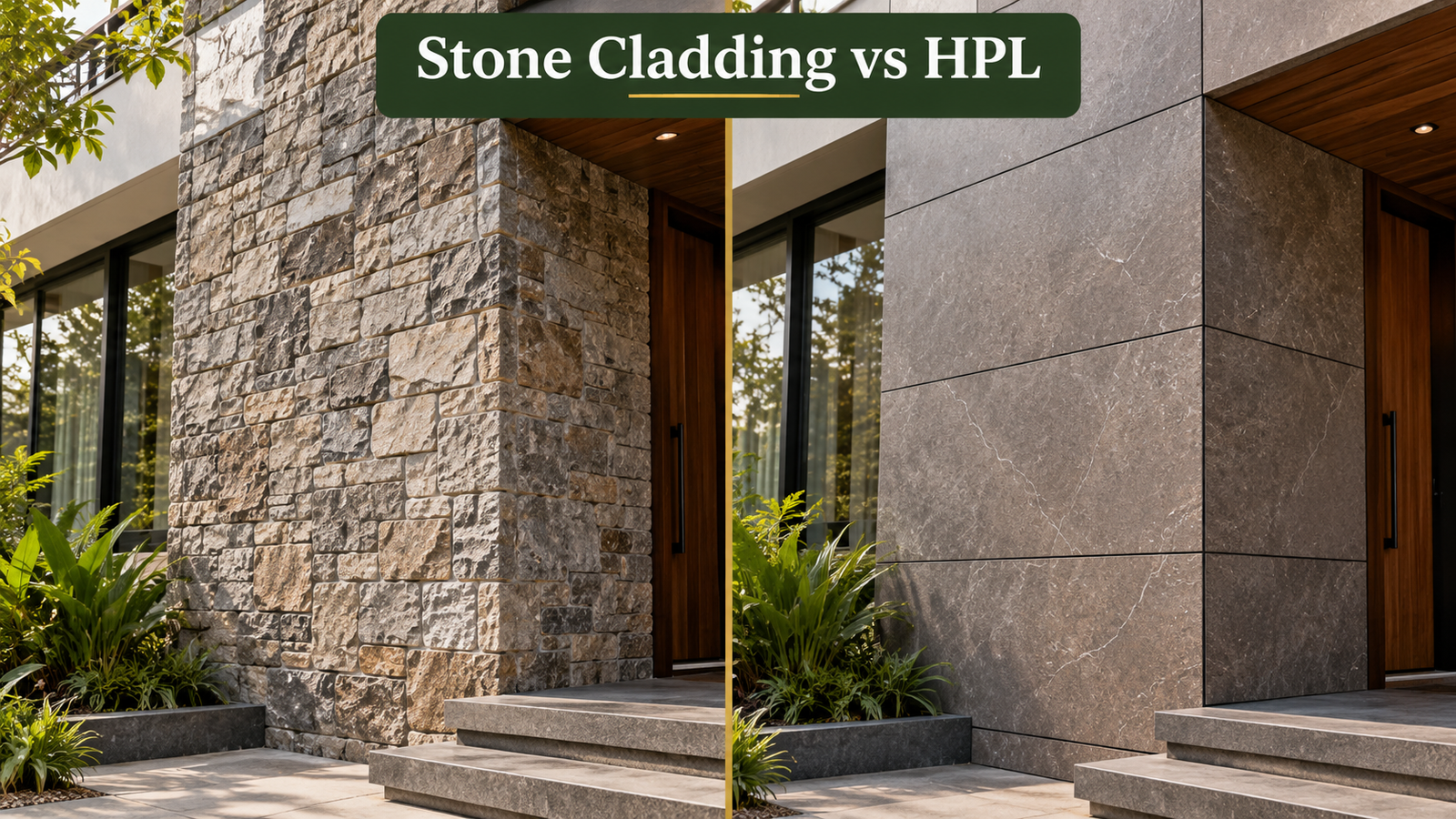
Stone has a pull that few materials can match. A stone-clad front wall looks solid, rich and permanent, which is exactly why so many Indian homeowners ask for it when they plan a new elevation. But a few monsoons later, many of those same owners are dealing with dark water patches, white salt marks and loose pieces near the parapet.
So the real question isn't "Is stone beautiful?" It clearly is. The question is whether natural stone is the smartest way to get that look on an exterior wall today, or whether an HPL stone-finish panel gives you the same feel with fewer headaches. This guide compares both honestly, including where stone still wins.
What Is Stone Cladding for Walls?
Stone cladding is a thin layer of stone fixed on the outside of a wall. It is not the wall itself; it is a decorative and protective skin. In India, the common choices are sandstone (like Dholpur or Jaisalmer stone), slate, granite and quartzite, usually cut into tiles or random "ledge" strips that are 15 to 25 mm thick.
Most stone cladding is fixed with cement mortar or tile adhesive directly onto the plastered wall. On taller or commercial buildings, good contractors also add steel clamps so that pieces can't fall if the adhesive fails.
You'll also hear about stone veneer sheets. These are very thin slices of real stone (often just 1 to 2 mm) bonded to a flexible fibreglass backing. They're lighter than full stone, but they are mainly meant for interior feature walls. Outdoors, under strong sun and heavy rain, the backing and adhesive are the weak points.
What Is an HPL Stone-Finish Panel?
HPL stands for High Pressure Laminate. Exterior HPL is made by pressing layers of kraft paper soaked in resin under very high heat and pressure until they turn into one dense, solid board. A printed stone design sits on top, sealed under a UV-protective coating so the colour holds up in direct sunlight.
The result is a panel that looks like stone from normal viewing distance but behaves very differently. It doesn't absorb water, it doesn't need sealing, and it is fixed on a metal frame rather than glued to the wall. HPLMaker's exterior HPL sheets come in stone, wooden and solid-colour series, so the stone look can be matched with other finishes on the same elevation.
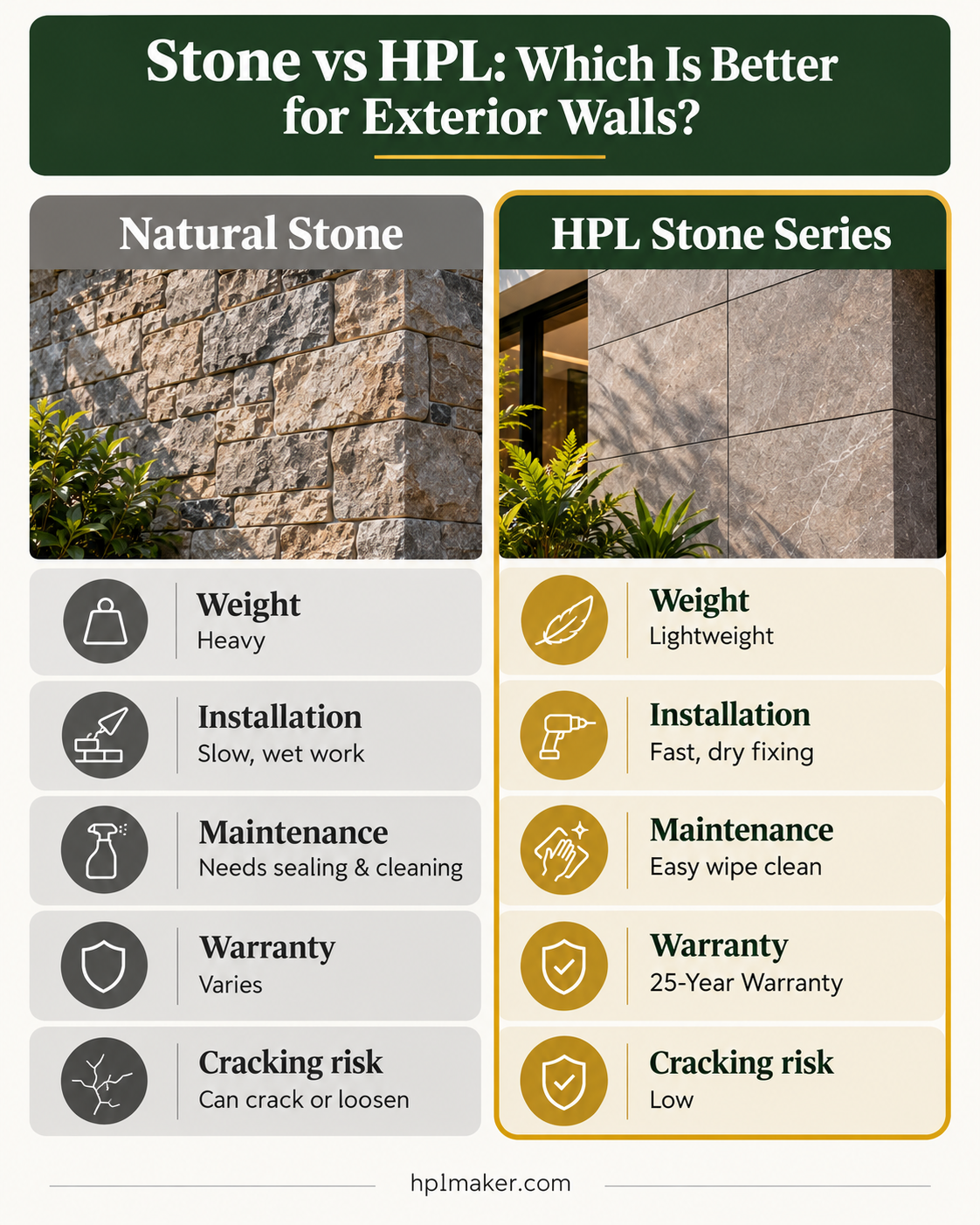
Stone vs HPL: The Comparison That Matters
Here's how the two stack up on the things that actually affect your wall over 20 years, not just on day one.
| Factor | Natural Stone Cladding | HPL Stone Series |
|---|---|---|
| Weight on the wall | Heavy: about 50 kg per sq metre at 20 mm | Light: roughly 8 to 9 kg per sq metre at 6 mm |
| Water absorption | Sandstone and slate absorb water | Near zero; surface doesn't soak water |
| Fixing method | Wet mortar or adhesive on the wall | Dry fixing on an aluminium frame |
| Installation time | Slow; needs curing and skilled masons | Fast; no curing time |
| Maintenance | Periodic sealing, cleaning of moss and salt marks | Wipe with water and mild soap |
| Colour consistency | Varies from batch to batch | Uniform across panels |
| Replacement | Break out and redo the area | Unscrew and replace one panel |
| Warranty | Usually none on the installed wall | 25-year warranty with HPLMaker |
The weight figures come straight from material density. Most building stone weighs around 2.6 to 2.7 grams per cubic centimetre, while compact HPL sits near 1.4. Put simply, a 20 mm stone layer puts about six times more load on your wall than a 6 mm HPL panel. On a two-storey front elevation, that is several tonnes of extra weight hanging off the plaster.
Why Stone Struggles on Indian Exterior Walls
Stone itself is tough. The trouble usually starts with how it meets our climate.
The monsoon problem
Popular cladding stones like sandstone are porous, which means they have tiny holes that pull in water. During the monsoon, water soaks in, carries salts from the cement behind it, and leaves them on the surface as it dries. That's the white powder (called efflorescence) you see on so many stone walls. Damp stone also attracts moss and black algae, especially on north-facing walls that never get full sun.
The heat problem
In summer, a west-facing wall can get very hot by afternoon and cool sharply at night. Stone, mortar and the wall behind it all expand and shrink at different rates. Over the years, this repeated movement weakens the bond. That's how pieces loosen, and on a high wall, a falling stone is a real safety risk.
The upkeep problem
To keep stone looking good, it should be sealed every few years and cleaned regularly. In practice, most homeowners never do it, because it means scaffolding, chemicals and a contractor. The stone slowly darkens and patches appear, and the "premium" look fades.
Where HPL Makes the Difference
HPL solves these problems because of how it's built and how it's fixed.
It keeps water out. The resin-pressed core is dense, so rain sits on the surface and runs off. There's nothing for salts or algae to grow in.
It lets the wall breathe. HPL is usually installed as a ventilated facade. The panels sit on an aluminium frame with a small air gap behind them. Air moves through that gap, carries away moisture, and cuts the heat that reaches your wall. We've explained this system in detail in our guide to ventilated facades with HPL.
It's fixed mechanically, not glued. Each panel is screwed or riveted to the frame. Nothing depends on adhesive holding up through decades of heat and rain. If one panel is ever damaged, you replace that panel alone, and the rest of the wall stays untouched.
It holds its colour. The UV-coated top layer protects the stone print from fading in strong Indian sun. That's why HPLMaker backs its exterior sheets with a 25-year warranty.
Modern Exterior Stone Cladding Ideas with HPL
Modern exterior stone cladding is less about covering the whole house and more about using stone where it creates impact. These layouts work especially well with HPL stone panels:
- Feature wall at the entrance: a stone-finish panel wall around the main door, with plain plaster on either side, draws the eye straight to the entry.
- Vertical columns: stone-clad columns on a white facade give a tall, clean, architectural look.
- Stone plus wood: pairing a grey stone finish on the ground floor with a wooden finish on the balcony above adds warmth without looking busy.
- Boundary walls and gate pillars: stone panels for walls around the gate make the whole property feel finished from the street.
- Full stone house cladding on one face: for a bold modern villa, one complete face in large-format stone panels with tight joints looks sharp and expensive.
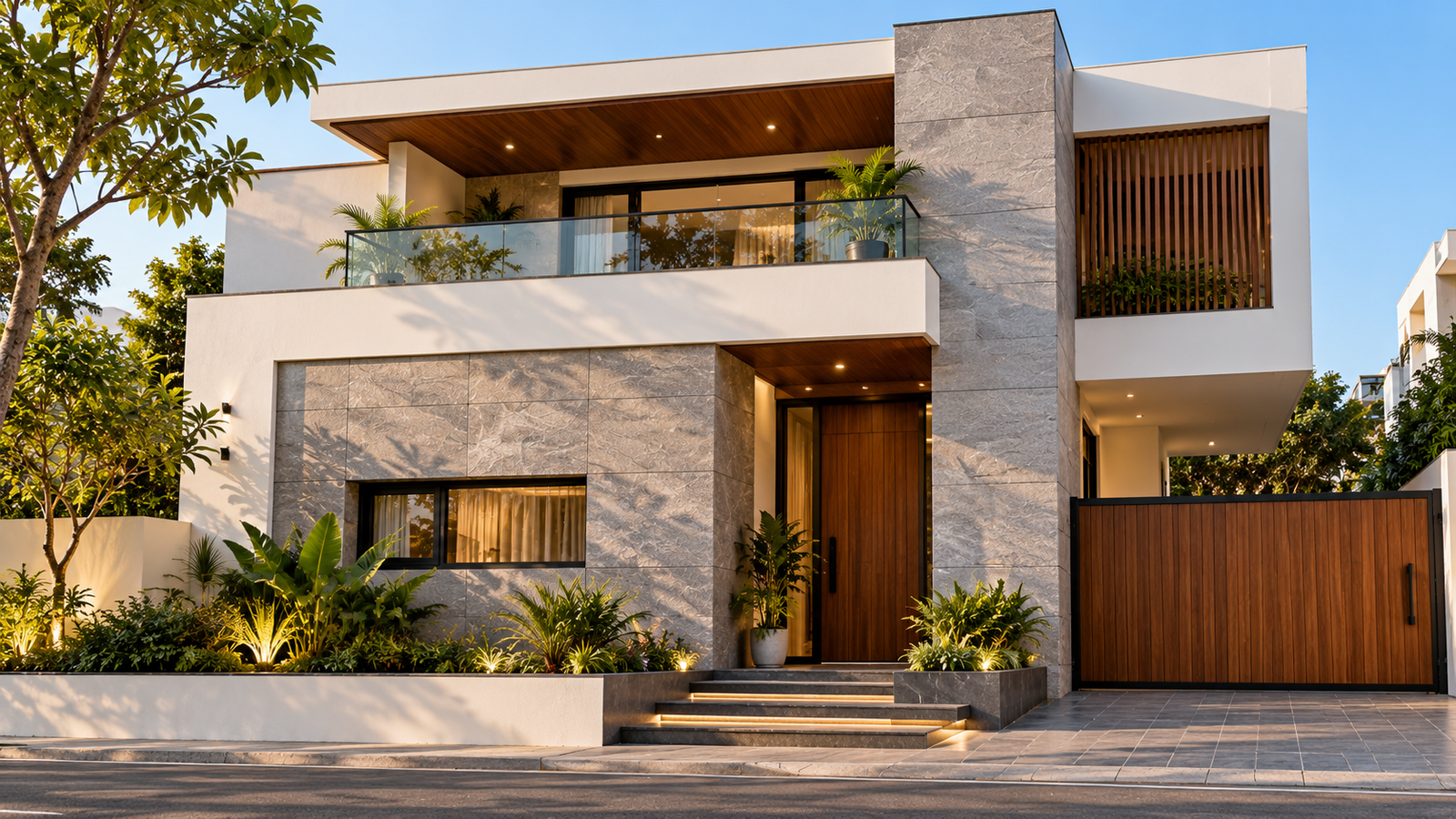
You can browse the full range of stone, wooden and solid shades on our HPLMaker shade card to plan combinations before you finalise a design.
When Natural Stone Is Still the Right Choice
To be fair, there are places where real stone makes sense. If you're restoring a heritage building, or the design depends on the raw, uneven depth of hand-cut stone that you can touch and feel up close, natural stone gives something a printed surface can't fully copy. Stone also works well at low heights, such as plinth bands, garden walls and steps, where weight and falling pieces are less of a worry.
For the main exterior walls of a modern home, where you want a consistent look, low weight, quick installation and almost no upkeep, HPL is usually the more practical choice.
How to Decide for Your Home
Ask yourself three quick questions.
- How high is the wall? The taller it is, the more weight and fixing safety matter, and the stronger the case for HPL.
- How much maintenance will you really do? If the honest answer is "very little," stone will slowly lose its look. HPL won't need it.
- Do you want one consistent finish? Natural stone varies from batch to batch. HPL panels match across the whole wall, and you can mix finishes on purpose.
Once you've chosen your shade, our team can guide you through the frame, joints and fixing details. You can read about the process on our HPL sheet installation page, or see why homeowners are moving to HPL cladding for their elevations.
Frequently Asked Questions
Is HPL better than stone cladding for exterior walls?
For most modern homes, yes. HPL stone-finish panels are much lighter, don't absorb water, need almost no maintenance and are fixed mechanically. Natural stone is still a good fit for heritage work or low walls where its raw texture matters most.
Does HPL stone cladding look like real stone?
From normal viewing distance, a good HPL stone-finish panel looks very close to real stone. Up close, it has a smooth surface rather than the rough depth of cut stone. Many owners prefer that, because it stays clean and doesn't trap dust or moss.
How long does HPL exterior cladding last?
Good-quality exterior HPL with a UV-protective top layer is built to last for decades outdoors. HPLMaker exterior sheets carry a 25-year warranty.
Can stone veneer sheets be used on exterior walls?
Stone veneer sheets are mainly made for interiors. Outside, constant sun and rain can weaken the flexible backing and adhesive over time. For exteriors, a full stone cladding system or an exterior-grade HPL stone panel is a safer choice.
Is HPL cladding heavy for the wall?
No. A 6 mm exterior HPL panel weighs roughly 8 to 9 kg per square metre, about one-sixth the weight of 20 mm natural stone cladding. That makes it suitable for upper floors and older walls too.
Want a stone look that stays new for years? Talk to the HPLMaker team for shade options, samples and a project quote.