
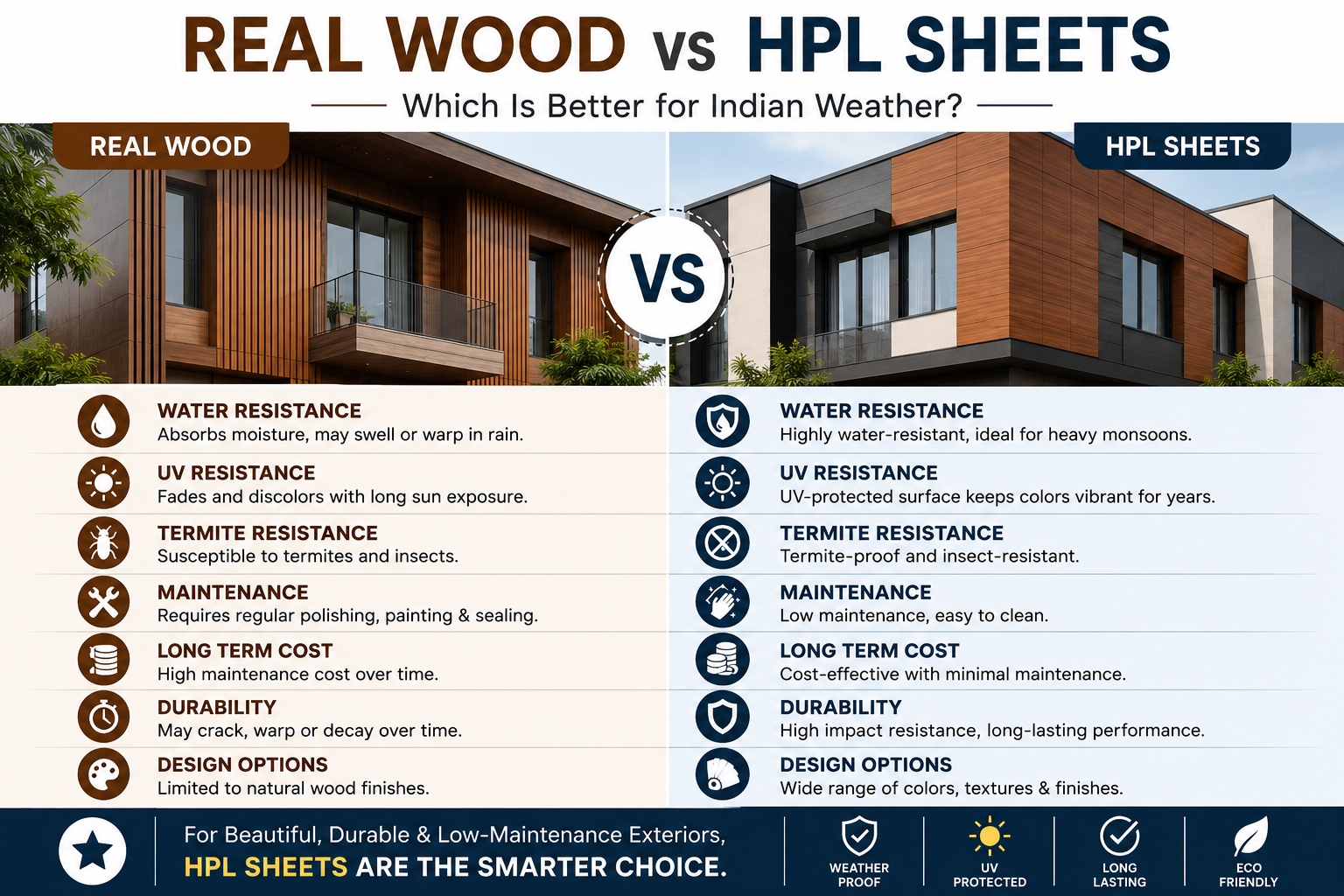
Modern Commercial Buildings Need More Than Just Good Design
In today’s competitive business environment, the appearance of a commercial building plays a significant role in shaping customer perception. Whether it’s a corporate office, shopping complex, hotel, educational institution, healthcare facility, or retail showroom, the exterior often becomes the first point of interaction between a brand and its audience.
However, aesthetics alone are no longer enough.
Architects are now expected to create structures that are visually appealing, durable, sustainable, cost-effective, and capable of performing in diverse weather conditions. This growing demand has led many professionals to move away from traditional facade materials and adopt modern solutions like High-Pressure Laminate (HPL) sheets.
Across India and international markets, HPL sheets have become a preferred choice for commercial projects because they successfully combine design flexibility with long-term performance.
The Challenges of Commercial Exterior Design
Commercial buildings face unique challenges compared to residential properties.
These structures are often exposed to:
- High foot traffic
- Continuous weather exposure
- Pollution and dust
- Strong UV radiation
- Long operating lifecycles
- Brand image requirements
A facade material must not only look attractive during installation but also maintain its appearance and functionality for years.
This is where HPL sheets offer a significant advantage.
What Makes HPL Sheets Ideal for Commercial Applications?
High-Pressure Laminate sheets are engineered by compressing multiple layers of kraft paper and decorative surfaces under high temperature and pressure.
The resulting product is highly durable, weather-resistant, and suitable for exterior applications.
Unlike conventional facade materials that may deteriorate over time, exterior-grade HPL sheets are specifically designed for demanding environments.
1. Premium Aesthetics That Enhance Brand Image
Commercial buildings often represent a company’s identity.
Architects seek materials that create a strong visual impact while maintaining a professional appearance.
HPL sheets are available in a wide variety of finishes, including:
- Wood textures
- Stone-inspired surfaces
- Metallic effects
- Solid contemporary colors
- Custom architectural designs
This design flexibility allows architects to create unique facades that align with a brand’s image and architectural vision.
Whether designing a luxury hotel or a modern corporate office, HPL sheets help deliver a premium and sophisticated look.
2. Excellent Weather Resistance
Commercial buildings are continuously exposed to environmental conditions.
Rain, heat, humidity, and sunlight can quickly affect inferior materials.
Quality HPL sheets offer:
- Moisture resistance
- UV protection
- Temperature stability
- Resistance to environmental wear
This makes them suitable for a wide range of climatic conditions, from coastal regions to hot urban environments.
Architects appreciate the reliability that HPL sheets provide over the long term.
3. Low Maintenance Requirements
Maintenance costs are a major concern for commercial property owners.
Traditional materials often require:
- Frequent repainting
- Surface restoration
- Protective coatings
- Repair work
HPL sheets significantly reduce these ongoing expenses.
Most facades can be maintained through simple periodic cleaning, helping businesses save time and money throughout the building’s lifecycle.
For commercial projects, reduced maintenance translates directly into lower operational costs.
4. Long-Term Durability
Commercial buildings are expected to remain functional and attractive for decades.
HPL sheets are known for their:
- Scratch resistance
- Impact resistance
- Surface durability
- Structural stability
This durability makes them particularly suitable for high-use environments where facade performance is critical.
Architects prefer materials that help minimize future renovation and replacement costs.
5. Faster Project Execution
Construction timelines are often strict for commercial developments.
Delays can result in financial losses and operational setbacks.
HPL cladding systems are designed for efficient installation, helping contractors complete projects faster compared to some traditional facade solutions.
Architects and developers appreciate materials that support both quality and construction efficiency.
6. Sustainable Building Design
Sustainability has become an important consideration in modern architecture.
Organizations such as the World Green Building Council continue to encourage the use of durable building materials that contribute to long-term environmental performance.
Because HPL sheets offer:
- Extended service life
- Reduced maintenance requirements
- Lower replacement frequency
they align well with sustainable construction goals.
Many commercial developers now prioritize durable facade systems as part of broader environmental strategies.
7. Design Freedom for Architects
Architects value creative flexibility.
Modern commercial projects often feature:
- Large elevations
- Geometric facade patterns
- Vertical cladding systems
- Decorative architectural elements
- Mixed-material designs
HPL sheets can be incorporated into all these applications.
Their versatility enables architects to experiment with textures, colors, and facade compositions without compromising performance.
This freedom makes HPL one of the most adaptable exterior materials available today.
Commercial Applications of HPL Sheets
HPL sheets are widely used across multiple commercial sectors.
Corporate Offices
Modern office buildings use HPL facades to create a professional and premium appearance.
Hotels and Resorts
Wood-finish HPL sheets help hospitality projects achieve luxurious aesthetics while minimizing maintenance.
Educational Institutions
Schools and universities benefit from durable and weather-resistant exterior surfaces.
Hospitals and Healthcare Facilities
Clean, long-lasting facade materials contribute to a modern institutional appearance.
Retail and Shopping Centers
Commercial retail spaces use HPL cladding to attract visitors and strengthen brand presence.
Why Leading Architects Choose HPLMaker
Selecting the right manufacturer is just as important as choosing the right material.
HPLMaker has become a trusted name among architects, builders, and developers seeking premium exterior cladding solutions.
Its product range is designed to meet modern architectural requirements, offering:
- Exterior-grade durability
- UV-resistant surfaces
- Realistic wood-finish textures
- Contemporary design collections
- Weather-resistant performance
- Low-maintenance facades
Whether working on a luxury commercial development or a large institutional project, architects rely on HPLMaker products to achieve both aesthetic and functional objectives.
Explore commercial facade solutions at HPLMaker Official Website.
The Future of Commercial Facades
Commercial architecture is evolving rapidly.
Property owners are increasingly looking for materials that:
- Enhance visual appeal
- Reduce maintenance costs
- Improve durability
- Support sustainability goals
- Deliver long-term value
HPL sheets successfully address all these requirements, making them one of the most future-ready facade solutions available today.
As commercial construction continues to embrace modern materials, HPL cladding is expected to play an even greater role in shaping the next generation of architectural design.
Conclusion
The growing popularity of HPL sheets in commercial projects is no coincidence. Architects need materials that combine aesthetics, durability, efficiency, and long-term performance, and HPL delivers on all fronts.
From corporate offices and hotels to educational institutions and retail developments, HPL sheets provide a versatile solution that helps buildings remain attractive and functional for years.
For businesses investing in modern architecture, HPLMaker offers premium exterior-grade HPL solutions that meet the demands of today’s commercial construction industry while preparing buildings for tomorrow’s challenges.