
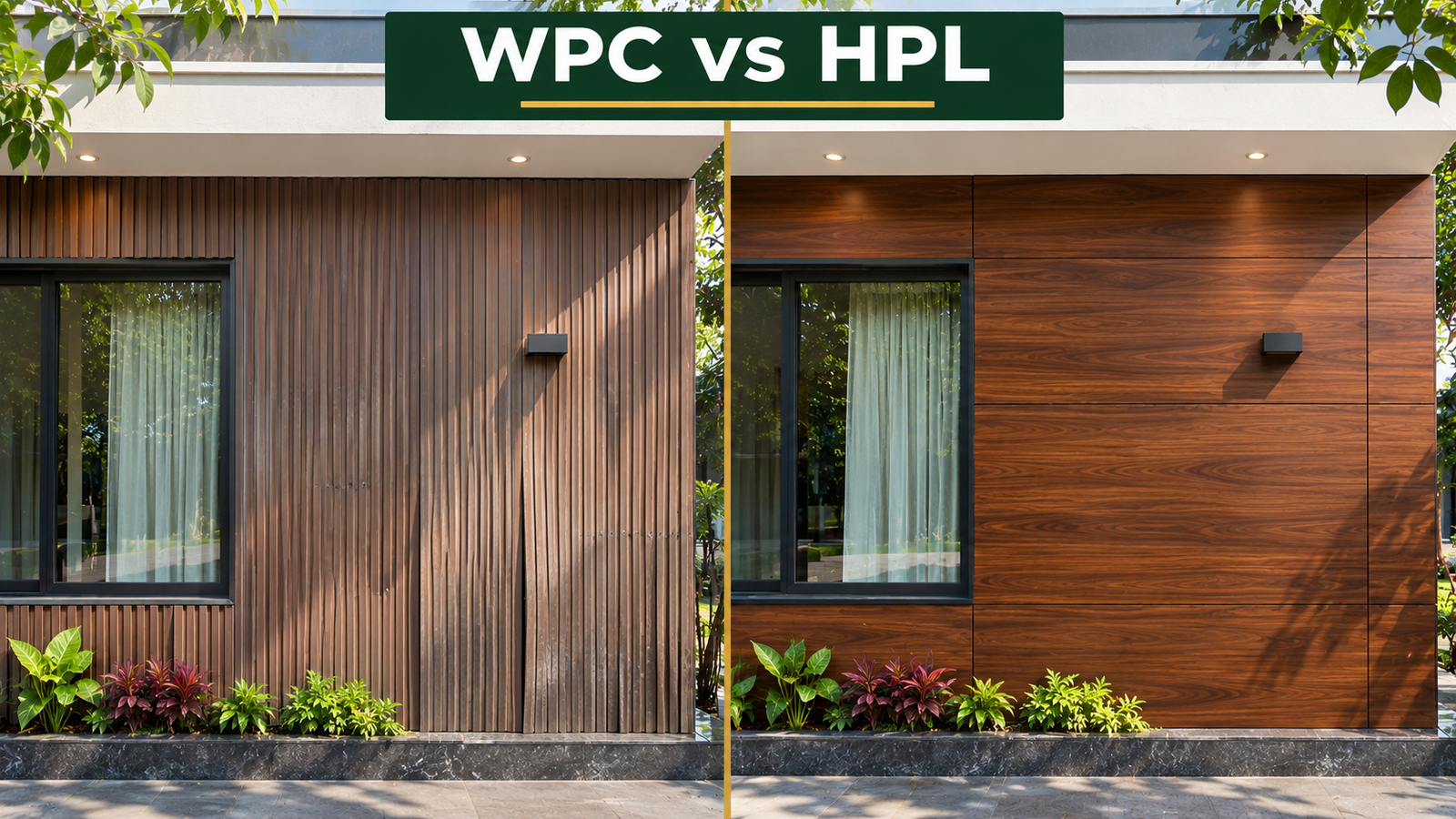
WPC and HPL both promise a wood look without real wood's headaches. They sound similar, they're often sold side by side, and their brochures make similar claims. Outdoors, though, they behave very differently. Here's what actually sets them apart.
If you’ve been shopping for exterior cladding, you’ve almost certainly been shown WPC. It’s everywhere: fluted panels on shop fronts, wood-look boards on balconies, louvres on new apartment buildings. Then someone mentions HPL, and you’re left wondering whether they’re basically the same thing.
They’re not. Both can look like wood, but they’re made from completely different materials, and that changes how they handle the Indian sun, rain and daily wear. This guide breaks down WPC vs HPL in plain language so you can choose the one that fits your wall.
For open, sun-facing exterior walls, HPL is usually the better choice. It’s a dense, heat-stable board with a UV-protected surface, so it stays flat and keeps its colour, and HPLMaker backs it with a 25-year warranty. WPC works well for decking, covered areas, louvres and budget projects where some expansion and fading over time is acceptable.
- WPC is wood flour mixed with plastic; HPL is resin-pressed paper layers fused into a solid board.
- Plastic-based WPC expands noticeably in heat, which can cause bowing and gaps outdoors.
- Many WPC products fade or chalk in strong sun, especially in darker shades.
- HPL offers far more designs: wood, stone, marble-look and solid colours.
- Choose by exposure: WPC for shaded or covered uses, HPL for full exterior elevations.
What Is WPC?
WPC stands for Wood Plastic Composite. Manufacturers grind wood into fine flour, mix it with a plastic such as PVC or polyethylene plus some additives, and push the hot mix through a mould. The result is a board or panel with a wood-like colour. Many WPC panels are hollow inside, with thin internal walls, to keep weight and cost down. Some have a co-extruded plastic cap on top for better weather resistance.
WPC became popular because it doesn’t rot like timber, termites don’t eat the plastic part, and it’s relatively affordable. It’s widely used for decking, fencing, pergolas and fluted wall panels.
What Is HPL?
HPL stands for High Pressure Laminate. It’s made by stacking sheets of kraft paper soaked in resin, adding a printed decorative sheet on top, and pressing the stack under very high heat and pressure. Everything fuses into one dense, solid board. Exterior-grade HPL gets a UV-protective top layer that keeps the colour stable outdoors.
The key difference: there’s no plastic melt in HPL. It’s a cured, pressed board, so it doesn’t soften with heat the way plastic-based products can. You can see HPLMaker’s exterior range on our exterior HPL sheets page.
WPC vs HPL: Side-by-Side
| Factor | WPC Cladding | HPL Cladding |
|---|---|---|
| What it’s made of | Wood flour + plastic (PVC or PE) | Resin-soaked paper layers, heat-pressed |
| Structure | Often hollow profiles | Solid, dense board |
| Heat behaviour | Expands noticeably; can bow | Stable in summer heat |
| Sun & UV | Can fade or chalk over time | UV-protective top layer |
| Water | Low absorption; wood content can swell at cut ends | Near-zero absorption |
| Design range | Mostly wood tones, fluted profiles | Wood, stone, marble-look and solid colours |
| Surface | Textured plastic feel | Smooth, premium sealed finish |
| Typical uses | Decking, louvres, covered walls | Full elevations, balconies, gates, facades |
| Warranty | Varies by brand | 25 years with HPLMaker |

Where WPC Runs Into Trouble Outdoors
Heat makes it move
Plastic expands when it gets hot and shrinks when it cools. WPC contains a large share of plastic, so it moves much more than a pressed board like HPL. A west-facing wall in Rajasthan, Madhya Pradesh or Gujarat can get very hot by afternoon. Over hundreds of hot days, that movement can lead to boards that bow between fixings, gaps that open and close at the joints, and clips that loosen.
Installers try to manage this by leaving extra expansion gaps. That helps, but it also means wider, more visible joints.
The colour can drift
WPC colour comes from pigments mixed into the plastic and wood blend. Under strong UV, many WPC products slowly fade, and the surface can turn chalky. Darker browns and greys usually show it first. Capped WPC holds up better than uncapped, but quality varies a lot between brands.
Hollow boards are easier to damage
Hollow profiles keep WPC light and affordable, but they’re weaker against impact. A ladder, a cricket ball or a car door can crack or dent a hollow board, especially near the edges. That matters on ground-floor walls, parking areas and gates.
Limited design range
WPC is almost always some shade of wood. If you want a stone look, a marble-look panel or a clean solid grey, you’ll need a second material, with a second fixing system and different joint lines.
Why HPL Performs Better on Exterior Walls
It stays flat. Because HPL is a cured, pressed board rather than a plastic extrusion, it handles summer heat without softening or bowing. That’s how an elevation keeps crisp, straight lines year after year.
The colour is protected. The decorative layer sits under a UV-protective coat, so wood and solid shades keep their depth. HPLMaker backs its exterior sheets with a 25-year warranty.
It’s solid all the way through. HPL is dense and impact-resistant. It handles the knocks a ground-floor wall or gate takes far better than hollow profiles.
One material, many looks. Wood, stone and solid finishes all come in the same HPL system. You can clad the balcony in walnut, the columns in stone and the main wall in charcoal grey, with matching joints and fixings. Browse the HPLMaker shade card to plan combinations.
It lets the wall breathe. HPL is fixed on an aluminium frame with an air gap behind it. That ventilated design carries away heat and moisture, which helps both the panel and your wall. Our guide to ventilated facades with HPL explains how.
Quick test at the shop: Press your thumb hard into the edge of a WPC sample and an HPL sample, then look at the cut edge of each. HPL’s edge is dense and solid all the way through; many WPC boards show a hollow, honeycomb-style interior.
Where WPC Is a Good Choice
WPC has real strengths, and it’s the right pick in several places:
- Decking and pool surrounds, where it’s designed to be walked on and has anti-slip textures.
- Pergolas, louvres and screens, where small gaps and some movement don’t matter much.
- Covered verandahs and ceilings, where the roof protects it from direct sun.
- Budget-driven projects, where lower upfront cost is the main goal.
Choose WPC if…
- It’s for decking, louvres or a pergola
- The area is shaded or covered
- Lowest upfront cost matters most
- You only need a wood look
Choose HPL if…
- It’s a main exterior wall in direct sun
- You want crisp, flat panels for years
- You want wood, stone and solid options
- You want a 25-year warranty
Using WPC and HPL Together
Many good designs use both. A common combination is HPL on the main elevation and balcony walls, with WPC decking on the balcony floor or WPC louvres as a sun screen. Each material does the job it’s best at. Just keep the wood tones close so they look planned, and use a professional installer for both.
How to Decide in 5 Steps
- Check the sun exposure. If the wall gets direct afternoon sun, HPL’s heat stability matters a lot.
- Decide the look. Only wood? Both work. Want stone or solid colours too? HPL covers all of them in one system.
- Think about knocks. Ground floors, gates and parking walls need impact resistance, so solid HPL is safer than hollow profiles.
- Count the long-term cost. Add likely repairs and replacement over 10 to 15 years, not just day-one price.
- Compare warranties in writing. Ask exactly what’s covered outdoors and for how long.
Planning your wall? Find out how many 8 × 4 ft HPL sheets you need in 30 seconds.
Open HPL Sheet CalculatorInstallation Differences
WPC panels are usually clipped or screwed to battens with generous expansion gaps, because the boards move with temperature. HPL is fixed to an aluminium sub-frame with smaller, planned joints and an air gap behind. Each 8 × 4 ft HPL sheet covers 32 sq ft, so large walls go up quickly with fewer pieces. Read more on our HPL sheet installation page.
Other Comparisons Worth Reading
If you’re still comparing materials, these guides help: PVC vs HPL, ACP vs HPL, wooden cladding vs HPL and our full facade cladding materials guide.
A Real-World Scenario
Picture two neighbouring houses built the same year, both with west-facing first-floor walls. One uses hollow WPC fluted boards, the other wooden-finish HPL. In the first summer, both look great. By the third summer, the WPC wall shows slightly wavy boards in the afternoon and uneven gaps at the joints, and its darker brown has turned a little chalky. The HPL wall still has straight lines and the same warm tone, and it only needs a wash before Diwali.
That’s the difference material science makes over time. It doesn’t show on day one, which is exactly why it’s worth understanding before you buy.
Frequently Asked Questions
Is HPL better than WPC for exterior walls?
For walls exposed to direct sun and rain, yes. HPL is a dense, heat-stable board with a UV-protected finish, so it stays flat and keeps its colour. WPC is a good choice for decking, louvres and shaded areas.
Does WPC expand in heat?
Yes. WPC contains a large share of plastic, which expands when hot and shrinks when cool. On sunny walls this can cause bowing and changing gaps at the joints unless generous expansion gaps are left.
Does WPC cladding fade?
Many WPC products fade or turn chalky over time in strong sun, especially darker colours. Capped WPC lasts better, but quality varies widely between brands.
Is WPC the same as HPL?
No. WPC is a wood flour and plastic composite pushed through a mould, often hollow. HPL is made by pressing resin-soaked paper layers under heat and pressure into one solid board.
Can I use WPC and HPL together?
Yes. A common approach is HPL on exterior walls and balconies, with WPC for decking or louvres. Keep the wood tones close so the design looks planned.
How long does HPL cladding last?
Exterior-grade HPL with UV protection is built for long outdoor life. HPLMaker exterior sheets carry a 25-year warranty.
Ready for an exterior that stays flat and fresh?
Talk to the HPLMaker team for wooden, stone and solid shades, samples and a project quote.
WhatsApp UsView Shade Card