
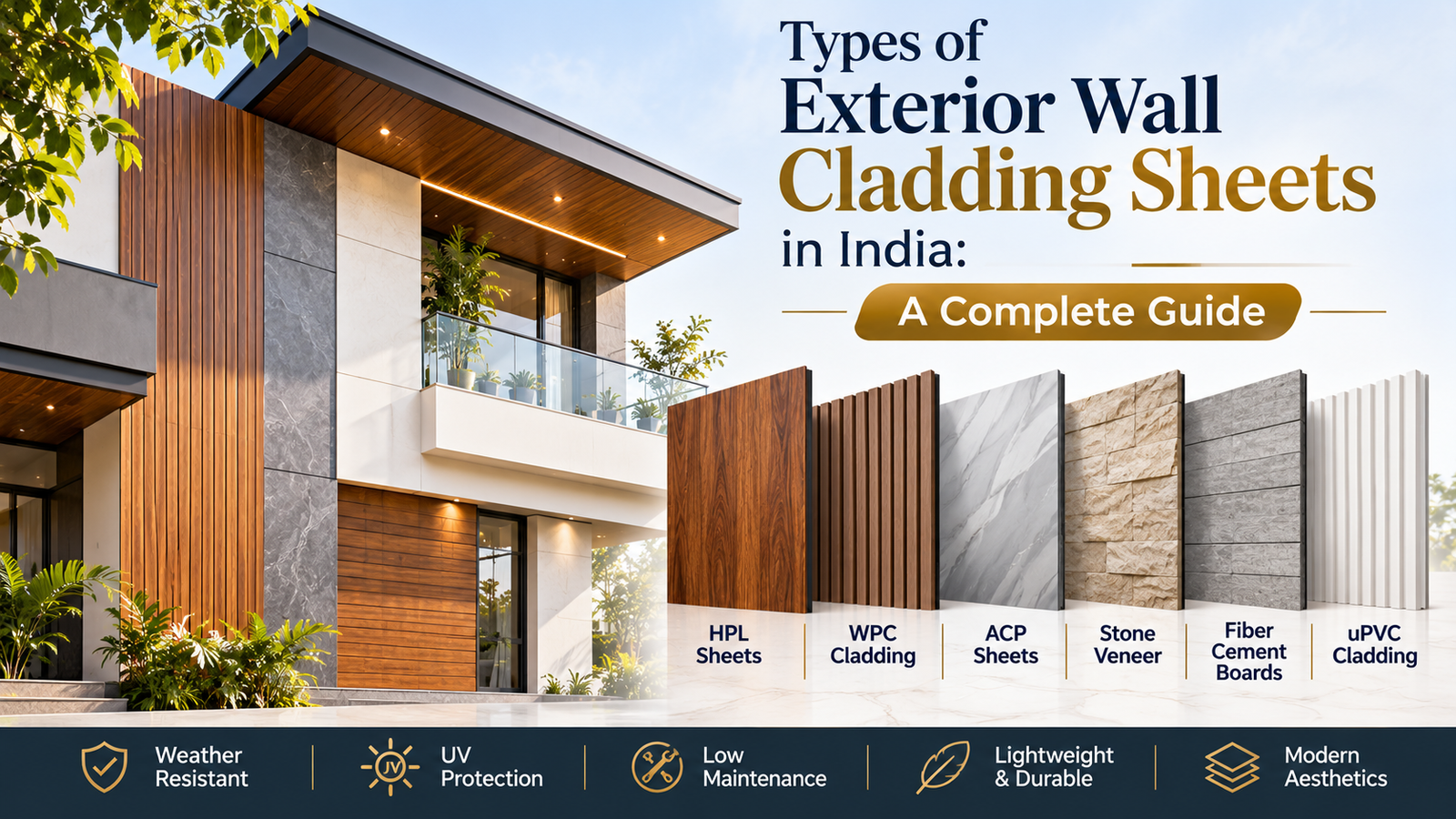
Walk into any building material market and you'll be shown a dozen kinds of "outdoor wall cladding sheets". Some are built for decades of sun and rain, others for a few years at best. This guide lines them all up so you can see the real differences.
“Exterior cladding sheet” sounds like one product, but it covers a whole family of materials. Some are pressed boards, some are plastic extrusions, some are metal sandwiches, and some are slices of real stone. Each behaves differently in Indian weather, and each suits a different budget and design.
This guide explains eight common types of exterior wall cladding sheets and panels in plain language, with honest pros and cons, so you can match the right sheet to your wall.
The eight common exterior wall cladding sheets in India are HPL, ACP, solid aluminium, fiber cement, WPC, PVC, natural stone and ceramic tiles. For most homes and mid-rise buildings, exterior HPL offers the best balance of design choice, weather resistance, light weight and low maintenance. Budget, building height and how much sun the wall gets decide which option fits best.
- Not every “outdoor” sheet is built for direct sun and monsoon rain.
- Plastic-based sheets (PVC, WPC) are affordable but move and fade more in heat.
- Metal sheets (ACP, aluminium) look sleek but dent and heat up.
- Fiber cement is affordable and non-combustible but needs repainting.
- HPL combines a wide design range with very low upkeep on open walls.
What Is an Exterior Cladding Sheet?
An exterior cladding sheet is a panel fixed to the outside of a wall to protect it from weather and give it a finished look. Most modern cladding sheets are fixed on a metal or timber frame with a small air gap behind them. That ventilated design lets the wall breathe and keeps moisture from getting trapped. Older methods stick the material directly onto the wall with mortar or adhesive.
1. HPL (High Pressure Laminate) Sheets
What it is: Layers of resin-soaked kraft paper with a decorative top, pressed under heat and pressure into a dense, solid board. Exterior-grade HPL has a UV-protective surface.
Pros: Wide design range (wood, stone and solid colours), near-zero water absorption, no painting, impact-resistant, light and quick to install.
Cons: Quality varies between brands; choose exterior grade with a written warranty.
Best for: Home elevations, balconies, gates, compound walls, shop fronts and mid-rise facades. HPLMaker sheets come in 8 × 4 ft with a 25-year warranty. See our exterior HPL sheets.
2. ACP (Aluminium Composite Panels)
What it is: Two thin aluminium skins bonded to a plastic or mineral core, usually 3 to 4 mm thick.
Pros: Sleek, flat, metallic look; light; easy to fabricate into shapes.
Cons: Dents easily, colours can fade or chalk, and the core type matters for fire safety; always ask for a fire-retardant core.
Best for: Signage bands, retail fronts, commercial facades with a glossy look. Compare in detail in our ACP vs HPL guide.
3. Solid Aluminium Panels
What it is: Single aluminium sheets, usually 2 to 3 mm, with a powder or PVDF coating.
Pros: Non-combustible, strong, can be perforated or folded into bold shapes.
Cons: High cost, limited natural textures, gets hot in direct sun.
Best for: High-rise and landmark commercial buildings with larger budgets.
4. Fiber Cement Boards
What it is: Sheets made from cement, sand and cellulose fibres, usually painted after installation.
Pros: Non-combustible, affordable, stable.
Cons: Needs regular repainting, absorbs moisture at cut edges, corners can chip.
Best for: Budget projects, service blocks and back walls.

5. WPC (Wood Plastic Composite) Panels
What it is: Wood flour mixed with plastic, pushed through a mould; often hollow.
Pros: Wood look, termite-resistant, affordable.
Cons: Expands noticeably in heat, can bow and fade in strong sun, hollow boards dent.
Best for: Decking, louvres, pergolas and covered areas. See our full WPC vs HPL comparison.
6. PVC Wall Panels
What it is: Plastic panels, usually hollow or foam-filled, with a printed surface.
Pros: Cheapest option, waterproof, very light, easy DIY installation.
Cons: Softens and expands in heat, can fade and turn brittle in UV, looks plastic up close.
Best for: Ceilings, bathrooms, covered verandahs and shaded utility areas. Read PVC vs HPL.
7. Natural Stone Cladding
What it is: Thin slabs or strips of sandstone, granite, slate or quartzite.
Pros: Authentic texture, premium natural look, long life.
Cons: Very heavy, porous stones absorb water and stain, slow wet installation, loose pieces are a risk on tall walls.
Best for: Plinths, garden walls and low feature areas. Our stone cladding vs HPL guide explains the trade-offs.
8. Ceramic and Vitrified Exterior Tiles
What it is: Fired clay or vitrified tiles fixed to the wall with adhesive.
Pros: Many designs, hard surface, affordable.
Cons: Grout lines collect dirt, tiles can debond and fall from height, heavy, slow to install.
Best for: Low walls, small feature areas and budget elevations. See HPL vs ceramic tiles.
All 8 Cladding Sheets Side by Side
| Sheet type | Design range | Sun & heat | Water | Upkeep | Weight | Relative cost |
|---|---|---|---|---|---|---|
| ACP | Metallic, solid | Can fade, heats up | Good | Low to medium | Very light | Low to mid |
| Solid aluminium | Metallic, perforated | Good, heats up | Excellent | Low | Light | High |
| Fiber cement | Paint colours | Paint fades | Edges absorb | Repainting | Medium | Low |
| WPC | Wood tones | Expands, can fade | Low | Low to medium | Medium | Low to mid |
| PVC | Printed patterns | Softens, fades | Waterproof | Medium | Very light | Lowest |
| Natural stone | Natural, varies | Good | Porous types absorb | Medium to high | Very heavy | Mid to high |
| Ceramic tiles | Many designs | Good | Grout absorbs | Grout cleaning | Heavy | Low to mid |
| HPL | Wood, stone, solid | UV-protected, stable | Near-zero | Very low | Light | Mid |
Simple rule: If the wall faces direct sun and rain and you want it to look new for years without repainting, focus on HPL, solid aluminium or good-quality stone. If it’s covered or shaded, cheaper options like PVC and WPC can work.
How to Choose the Right Sheet
- Check exposure. Direct sun and open rain need materials built for UV and heat.
- Decide the look. Natural wood or stone feel? Sleek metal? Plain paint?
- Consider height and fire rules. Taller and commercial buildings may need specific fire performance; check local norms.
- Think about weight. Older buildings and upper floors suit lighter sheets like HPL or aluminium.
- Count 10 to 15 years of upkeep, not just the day-one price.
- Ask for a written outdoor warranty from the supplier.
For a broader view of facade materials, read our facade cladding guide.
Planning your wall? Find out how many 8 × 4 ft HPL sheets you need in 30 seconds.
Open HPL Sheet CalculatorSheet Size and Planning
Most cladding sheets come in standard sizes, and planning your layout around them saves money. HPLMaker exterior HPL comes in 8 × 4 ft (2440 × 1220 mm), covering 32 sq ft per sheet. Align joints with windows, slabs and corners, and add around 10 percent for cutting wastage. Our HPL sheet installation page explains how panels are laid out and fixed.
Cladding Sheets by Building Type
Independent houses and villas
HPL is the most versatile choice here, giving wood, stone and solid finishes for elevations, balconies, gates and compound walls. Natural stone can be used on small low areas.
Apartments and mid-rise buildings
HPL and ACP are common for facades, with HPL preferred where a natural look and impact resistance matter. Check local fire rules for the building height.
Shops and showrooms
HPL for a premium, durable front; ACP for flat, glossy signage bands. Our shop front design guide has ideas.
High-rise commercial towers
Solid aluminium and other non-combustible systems are often specified, depending on local fire norms, with glass curtain walls.
Budget and utility buildings
Fiber cement and PVC can make sense for back walls, service blocks and covered areas.
Thickness and Grade Matter Too
Within each material, there are better and worse grades. Thin interior panels sold as “outdoor” sheets are a common problem, especially with HPL, PVC and ACP. Always ask for the thickness, the grade and whether the product has UV protection for outdoor use. Our guide on HPL sheet vs panel vs board explains this for HPL, and our HPL quality checklist shows what to look for.
Why Ventilated Systems Work Better
Most modern cladding sheets, including HPL, ACP and aluminium, are fixed on a frame with an air gap behind them. This ventilated design has three big benefits:
- The wall stays drier, because moisture can escape through the gap.
- The building stays cooler, because heat on the outer panel is carried away by rising air.
- Panels can move slightly with temperature without cracking or bowing.
Our guide to ventilated facades with HPL explains the science in simple terms.
Frequently Asked Questions
What are the types of exterior wall cladding sheets?
The common types in India are HPL, ACP, solid aluminium, fiber cement, WPC, PVC, natural stone and ceramic or vitrified tiles.
Which cladding sheet is best for exterior walls?
For most homes and mid-rise buildings, exterior HPL offers the best balance of design range, weather resistance, light weight and low maintenance.
Are PVC sheets good for outdoor walls?
PVC works best in covered or shaded areas. In direct sun it can soften, expand, fade and turn brittle.
Which cladding sheet needs the least maintenance?
Exterior HPL and solid aluminium need very little maintenance. HPL usually just needs cleaning with water and mild soap.
What size are HPL cladding sheets?
HPLMaker exterior HPL sheets come in the standard 8 × 4 ft size (2440 × 1220 mm), covering 32 sq ft each.
Are lightweight cladding sheets better for upper floors?
Yes. Lighter sheets like HPL and aluminium add less load to the structure and are safer to fix at height than heavy stone or tiles.
Found your cladding sheet?
Explore HPLMaker exterior HPL in wood, stone and solid finishes, with a 25-year warranty.
WhatsApp UsView Shade Card